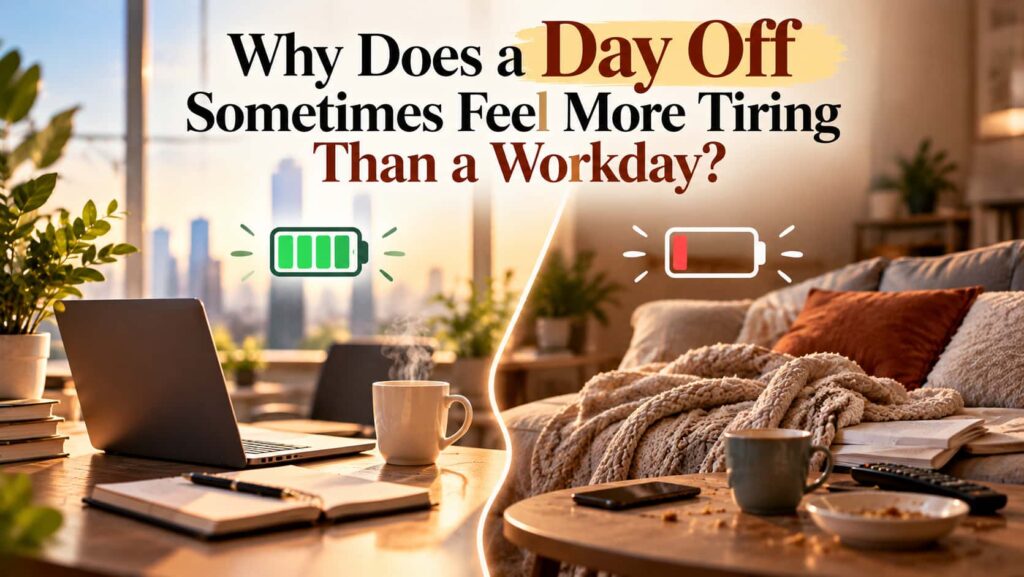
Why Does a Day Off Sometimes Feel More Tiring Than a Workday?
You Finally Get a Day Off. And Then You Get Busy. All week you are waiting for Sunday. Not in a dramatic way, just in that quiet, persistent way where Sunday starts feeling like the goal. Friday evening arrives and there is a specific quality of relief, the weekend ahead, the absence of Monday for two entire days. Saturday morning. You sleep a little later. You lie there for a few minutes thinking about how nice it is to have nowhere to be. Then your brain starts. Need to do the laundry before it piles up further. Need to buy groceries, the fridge is basically empty. Need to reply to all those messages that have been sitting there. Need to clean the bathroom, it has been a week. That bill needs to be paid. Maa said come for lunch, so that’s the afternoon gone. Need to drop that thing to the courier. Oh, and the thing I’ve been meaning to do for three weeks. You start moving. You get through it. By evening, you’re on the sofa, phone in hand, watching something while also scrolling something else. Sunday night arrives with its particular flavour of dread, and you realize you are still tired. How can a day when you technically did not work leave you feeling like you need another day off? A Day Without Work Is Not Automatically a Day of Rest Here is the thing. A workday has meetings, deadlines, commutes, and responsibilities that belong to work. We know those things are tiring and we accept that. But a day off can still contain chores, errands, household decisions, social obligations, the mental load of managing everything that did not get done during the week, and several hours of screen time that feels relaxing but often is not. The category changed. The busyness did not. When we say we want a day off, what we usually mean is that we want to stop being occupied by things that feel like obligations. But the weekend to-do list is still a to-do list. The laundry is still a task. The family lunch still requires your presence and attention. The WhatsApp messages still want a reply. We did not stop being busy. We just changed the department. A day off from work is not the same as a day off from being a person with responsibilities. Those are two different things, and we frequently confuse them. The Weekend To-Do List Is Still a To-Do List Monday to Friday, you have a work to-do list. Saturday and Sunday, you have a life to-do list. The format is identical. The checklist is equally long. The only difference is the font on the header. Most working adults spend a meaningful portion of the weekend doing things that accumulated during the week precisely because the week was too full to do them. Groceries, cleaning, laundry, maintenance tasks, family commitments, bill payments, and the various small administrative tasks of being an adult. These are not optional. They have to happen. But treating the time spent on them as rest is like treating a lunch break spent replying to emails as actually taking a break. You did things. But resting and doing things are not the same activity, even when the things are not called work. Why Scrolling Does Not Always Feel Like Rest After the chores are done, the sofa. Instagram. Reels. Maybe some YouTube. A show, or half a show, or seventeen minutes of four different shows. That thing you saved to watch later, which you watch for ten minutes and then abandon for something else. This is what rest looks like for a lot of people most weekends. And it is not a terrible way to spend time. But there is a difference between stopping work and actually giving your attention a break. While you are scrolling, you are processing: images, reactions, comparisons, opinions, news, other people’s holidays, other people’s kitchens, other people’s lives. Your body is on the sofa but your attention is moving constantly, faster than you would move through any real environment. The brain is still active. The restlessness is still there, just pointed in a different direction. This does not mean that all screen time is harmful or that every reel is a problem. It means that there is a difference between the kind of rest that leaves you feeling replenished and the kind that simply passes the time until you have to do something else. Why We Fill Every Free Hour Ask someone what they would do with a completely unplanned afternoon and many people go slightly blank. Not because they have no desires, but because unstructured time has become genuinely unfamiliar. Modern life runs on a schedule. Work has a structure. The weekend fills in the gaps work left. Even leisure tends to be organized: plans, bookings, things to catch up on. When time is actually empty, something uncomfortable can arrive. A vague guilt that you should be using it for something. A restlessness that reaches for the phone before a thought has fully formed. The sense that just sitting is somehow wasteful or self-indulgent. When did relaxing become something we also had to be productive at? When did rest become something that needed to be earned or justified? It happened gradually, and it shows up on weekends as an inability to simply be without also doing something that can be accounted for by the end of the day. The Home Environment Keeps the Routine Running There is something specific about being at home that makes it hard to actually switch off. Not because home is a bad place, but because home is also where all the responsibilities live. The laundry pile is visible. The dishes are there. The cupboard that needs sorting has been in your peripheral vision for two weeks. The laptop is on the table. The charger is plugged in. Everything that belongs to your regular life is in the same room with you,