
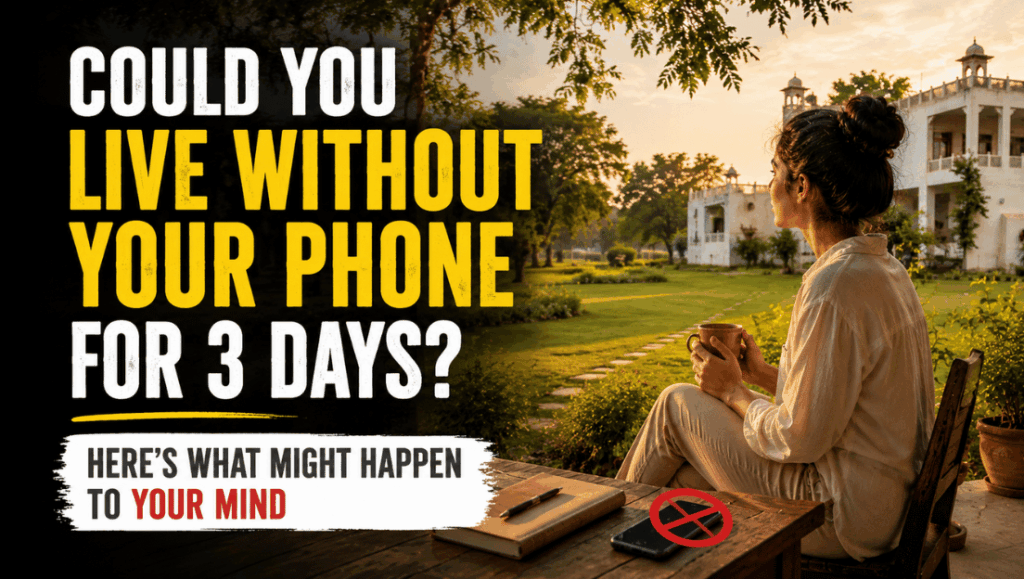
The alarm rings. You pick up your phone to stop it.
There is one WhatsApp message. You check it. Then an Instagram notification catches your eye. Then one reel. & Then another. You check the weather, open your email, perhaps skim some news.
Suddenly, twenty minutes have passed. You have not even left your bed.
Now here is the question worth sitting with: what would happen if, for just three days, you stopped giving your phone access to every empty moment of your life?
No Instagram. No endless reels. & No checking notifications every few minutes. & No reaching for the phone simply because you are bored.
Not forever. Just 72 hours.
Could you actually do it?
Before the Experiment: How Did We Get Here?
Think about the ordinary moments of an ordinary day. The phone is there when the alarm goes off. It comes to the bathroom. It sits beside the plate during meals. & It is on during conversations, during television, during the lift ride between floors, during the two-minute wait in a queue that once simply required standing.
None of these feel dramatic. Each one is a small, automatic reach. The hand moves before the mind decides anything. The phone is already open before any clear reason has been formed.
We no longer reach for our phones only when we need them. We reach for them whenever life becomes quiet.
That shift, from tool to default response to silence, is where this article begins.
Why Is It So Difficult to Put the Phone Down?
The answer is not weakness or poor self-discipline. It is design.
Apps are built around the same psychological principle that makes gambling compelling: unpredictable rewards. Each swipe might bring something funny, something surprising, a message, a compliment, something that triggers a small surge of emotion. The brain responds to this unpredictability by staying alert, by keeping the thumb moving, because the next piece of content might be the one that actually satisfies.
The problem is not that every piece of content is interesting. The problem is that the next one might be.
Add to this the social validation of likes and replies, the constant novelty of new content, and the instant escape from boredom or discomfort that a phone provides, and you have a system that the human brain was not designed to resist without effort.
Is Your Brain Actually Rotting?
Brain rot is not a medical diagnosis. It is a term people use to describe a feeling, one that is increasingly common: mental fog, scattered attention, compulsive scrolling, and a growing difficulty engaging with anything that moves slowly.
It shows up in recognizable ways:
- Long articles become hard to finish.
- Videos feel watchable only at 1.5 times the speed.
- Slow conversations produce a restless urge to check the phone.
- Sitting quietly for five minutes without reaching for something feels genuinely uncomfortable.
The question is not whether technology is causing permanent damage. The question is simpler and perhaps more honest:
Have we become bored more easily, or have we simply forgotten how to be bored?
The Hidden Cost of Never Being Bored
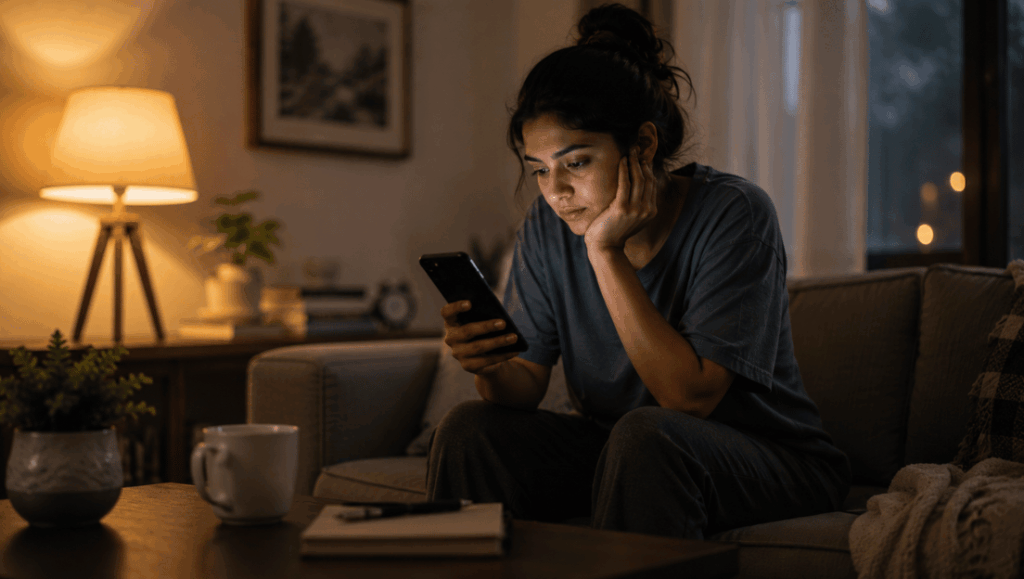
Boredom was never just discomfort. It was also the condition in which the mind did its quieter work: daydreaming, reflecting, processing emotions, arriving at ideas that did not come from anywhere in particular.
Now every tiny gap is immediately filled.
Waiting for a friend? Scroll.
Waiting for food? Scroll.
Travelling? Scroll.
Before sleeping? Scroll.
The gaps have been sealed with content.
We have eliminated boredom. But perhaps we have also eliminated some of the quiet spaces in which original thoughts appear.
The 72-hour experiment is partly about putting the phone away. But it is also about finding out what returns when the gaps are allowed to exist again.
The 72-Hour Experiment
Here is what the three days might actually look like. Not the version from a wellness blog where everything becomes peaceful by lunchtime on Day One. The honest version.
The First Few Hours: Where Is My Phone?
The reaching starts almost immediately. Not because anything specific needs to be checked, but because the hand moves there automatically. There is a phantom sense that something is waiting, something is happening, something needs a response.
This is the moment that reveals how deep the habit runs. The urge to check is not coming from need. It is coming from conditioning. And noticing that, feeling it clearly, is already the most useful thing the experiment offers.
Day One: Boredom and Restlessness
The first day is not magical. It is probably uncomfortable. There is boredom. There is restlessness. & There is the nagging sense that notifications are accumulating somewhere, that something is being missed.
This is important to sit with rather than escape. Because the discomfort is honest. It shows exactly how much the mind has been outsourcing its regulation to a device.
On the first day, you may not miss your phone. You may miss constant stimulation. Those are different things.

Day Two: Attention Begins Returning to Real Life
Something starts shifting. Breakfast takes longer and it is noticeable. Not because it changed, but because there is now enough attention available to actually be there for it.
- You might notice how long a conversation can last when neither person is checking anything.
- You might notice how many birds there are in the morning.
- You might notice how much of the day there actually is when it is not divided into scrolling intervals.
The exact experience varies. The point is not a particular discovery. The point is that things become visible when attention stops being constantly fragmented.
Day Three: Life Starts Feeling More Spacious
By Day Three, different rhythms have begun forming.
- Reading for longer than usual.
- Walking without a destination or a soundtrack.
- Cooking something slowly.
- Sleeping earlier because the final scroll before bed has been removed.
The day feels different in a way that is hard to describe precisely but very easy to feel.
Perhaps you did not need more hours in your day. Perhaps you needed fewer things interrupting the hours you already had.
What Might Change After Three Days?
This section should come with an honest disclaimer: three days will not rewire the brain. The goal is not transformation. It is observation. But observation, done carefully, can shift things.
- Attention: without constant digital interruptions, sustained focus on a single activity can begin to feel easier and more natural.
- Sleep: removing late-night phone use often improves the quality of falling asleep, even within a few nights.
- Mental space: more room becomes available for reflection, for thoughts that are not responses to something just consumed.
- Relationships: conversations become longer and richer when neither person is repeatedly glancing at a screen.
- Awareness: surroundings that were previously background become foreground. Ordinary moments become more noticeable.
- Sense of time: a day that is not constantly divided by checking behavior feels less fragmented and more whole.
Why a Digital Detox at Home Can Be Surprisingly Difficult
Here is the honest problem with trying this at home.
At home, the Wi-Fi is always on. The charger is beside the bed. Work notifications continue arriving. The sofa is associated with scrolling because that is what happens on it every evening. Everyone around you may be using their devices. The environment itself is full of habit cues, small triggers that prompt the same responses they always have.
Sometimes, to interrupt a familiar pattern, it helps to temporarily step outside the environment in which that pattern was built.
This is not a failure of willpower. It is how habits work. The context carries the behavior, which is why changing the context can do in a day what willpower alone struggles to do in a month.
Why Nature Makes Digital Detox Feel Less Like Deprivation

When the phone is taken away, it leaves a space. And the difficulty of most digital detox attempts is that the space is left empty, and empty space, for a mind trained on constant stimulation, is very hard to tolerate.
Nature fills that space differently from a screen. Not with content that demands a response, but with the kind of sensory experience that the nervous system recognizes as genuine rest: birds, wind, changing light, the sound of leaves, the feel of real ground underfoot.
In nature, you can watch a single cloud move across a sky for five minutes and feel, at the end of it, that the five minutes were well spent. A screen makes five minutes feel inadequate. Nature makes it feel like enough.
The phone gives your mind something new every few seconds. Nature teaches your mind to stay long enough to notice what is already there.
Nature also gives people something to do that is not scrolling. Walking, observing, gardening, sitting by water, watching a sunset: these activities occupy the attention without exhausting it. They are the kind of rest that leaves you more present than before, rather than less.
A Practical 3-Day Digital Detox Plan
Before You Begin
- Tell family and essential contacts that you will be less reachable and how to reach you in a genuine emergency
- Complete any urgent work or communications
- Decide your rules clearly: phone off completely, or phone kept for emergencies only with social apps removed
- Carry a physical book and a notebook
- Download or print anything genuinely necessary offline
Day One: Observe
Notice every moment you want to reach for the phone. Do not judge it. Just ask: what triggered that urge? Boredom, anxiety, habit, loneliness, a gap in conversation, or simply not knowing what to do with your hands?
Day Two: Replace
Replace scrolling with experiences: nature walks, gardening, cooking something slowly, reading, sketching, long conversations, watching the sunrise or sunset. Not as tasks to complete. As things to actually be in.
Day Three: Reflect
Journal around a few honest questions. What did you miss? What did you not miss at all? When was the urge strongest, and what was underneath it? What did you notice around you that you usually do not see?
What Happens on Day Four?
Most digital detox articles stop at Day Three. But Day Four is actually the most important question.
Will everything go back to exactly the same? Or can 72 hours of observation change something small, but real, about the relationship with the phone?
Here are a few habits that many people find sustainable after a detox:
- The first thirty minutes of the morning kept phone-free
- Meals eaten without the phone present
- Phone left outside the bedroom at night
- A weekly screen-free evening
- Social media apps checked in specific windows rather than whenever the mind wanders
- Regular time in nature as a genuine reset, not a luxury
The goal of a digital detox is not to prove that you can live without technology. It is to prove that technology can exist in your life without controlling your attention.
What If Real Life Became More Interesting Than the Screen?

Perhaps the easiest way to stop looking at a screen is not to keep telling yourself, do not look at the screen.
Perhaps it is to go somewhere where there is finally something else worth looking at.
Waking with natural light instead of an alarm notification. Drinking tea slowly on a verandah with no inbox waiting. Walking through open fields and noticing what is actually there. Watching a sunset without feeling the pull to photograph it. Ending the day under a genuinely dark sky full of stars, without a final scroll.
At Off Grid Rajasthan, we are not here to take your phone away. We want to offer you an experience where, for a while, you may simply not feel the need to keep reaching for it.
- Open Rajasthani countryside with no city noise to scroll past
- Organic farm-fresh meals eaten slowly and together
- Sunrise walks, barefoot ground, birds that reward actual attention
- Stargazing under skies that have not been dimmed by artificial light
- A pace that the body recognizes as rest, not one that mimics it
Plan your stay at Off Grid Rajasthan
www.offgridrajasthan.com
Before You Go
A few questions worth sitting with.
- Could you go without your phone for three days?
- What would you actually miss?
- What might you not miss at all?
- What might you rediscover?
And perhaps the biggest question of all:
If you stopped looking down at your screen for 72 hours, what might you finally look up and see?
Off Grid Rajasthan
Farmstay · Organic Living · Nature Retreat · Rajasthan