
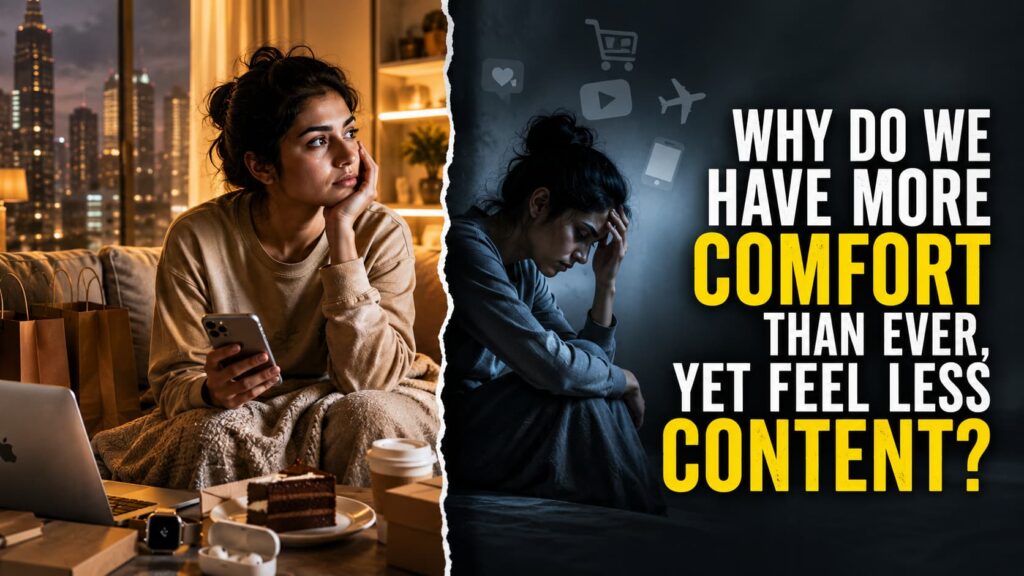
We Have Never Been More Comfortable
Food reaches the doorstep. Shopping requires no queue and no commute. Cars take us everywhere. We can talk to anyone on the other side of the world in seconds. AI answers questions that once required a library. Entertainment is available in unlimited quantity at any hour of the day or night.
By almost every measurable standard, life in the modern world is more comfortable than it has ever been for more people. And that is genuinely worth acknowledging. Comfort is not the enemy. It is one of the real achievements of the last century.
And yet. Many of us feel constantly tired. Mentally busy in a way that does not seem connected to how much we have actually done. Strangely dissatisfied, not quite able to name what is missing, but aware that something is.
If life has become easier, why does it so often feel heavier?
That is not a rhetorical question. It has a real answer. But to find it, we have to look not just at what modern life has given us, but at what it has quietly taken away in the process.
Somewhere, Convenience Became the Goal
The desire for convenience is entirely human. Nobody chooses difficulty for its own sake. When an easier option is available, taking it is rational. Technology developed precisely to remove friction from daily life, and it has done that extraordinarily well.
But somewhere along the way, the removal of friction stopped being a means to an end and became the end itself. Every bit of effort began to seem like a problem to be solved.
Walk less. Wait less. Cook less. Move less. Think less. Be patient less.
The result is a life with very little friction, very little resistance, and, it turns out, very little of the texture that friction and resistance once created.
What We Gained, and What We Slowly Lost
The clearest way to see what has shifted is to look at how daily movement has changed. Earlier generations often walked more, cycled more, climbed stairs, worked with their hands, and spent more time outdoors, not because they were pursuing health or fitness, but because that was simply what daily life required.
Today, we sit: at desks, in cars, on sofas, in front of screens. Then we schedule exercise into our calendars to replace the movement that has been engineered out of our daily routines.
Consider this: years ago, many people cycled because it was a practical way to get from one place to another. Today, many of us drive to the gym so we can ride a stationary bicycle. The movement is the same. The experience is entirely different.
We often pay to recreate what everyday life once gave us naturally. That pattern tells us something important about what has changed.
It is not just movement. Children who once played outdoors by default now require parents to organize weekend nature activities. Fresh home-cooked meals that were once simply how people ate have been replaced by convenience food, followed by a growing interest in organic living and mindful eating. Conversations that happened naturally across a shared meal have been replaced by digital communication, followed by workshops on how to have better conversations.
This is not an argument that the past was better. It is an observation: when we remove something from daily life by making it unnecessary, we often later seek it out deliberately, at greater effort and expense, because it turns out we needed it.
The New Lifestyle Our Bodies Never Really Asked For
The modern default is a specific set of conditions that no human body in the history of our species has ever been designed for: long unbroken hours of sitting, constant low-grade screen exposure, very little natural movement, limited sunlight, minimal face-to-face interaction, and almost no genuine quiet.
Individually, each of these might seem minor. Together, they create an environment that the human body and mind find quietly exhausting to live in, because nothing about them matches what we were actually built for.
This shows up not just in physical symptoms but in how we think and feel. A day spent entirely at a screen can leave a person feeling drained without being able to point to anything that caused the drain. A week with very little physical movement can produce a kind of low-level restlessness that is hard to name. A month without genuine stillness or time in natural environments can make the world feel slightly unreal.
The environment shapes the experience. When the environment changes as significantly as ours has, the experience changes with it, whether we consciously register the change or not.
The Comparison Trap
Now shift from the body to the mind, and to something that the previous generations did not have to navigate in quite the same way.
You are happy with your home. Then you see someone else’s on Instagram. You felt genuinely grateful for your holiday. Then someone posts photographs from a different country and something shifts. Nothing in your actual life changed. Only your perspective did.
Social media is not inherently bad. It connects people, shares ideas, creates community, and gives access to perspectives that would otherwise be invisible. But constant exposure to curated versions of other people’s lives has a particular effect on the mind: it quietly moves the goalpost for what counts as enough.
Comparison has a way of turning ‘enough’ into ‘not yet.’ And when everything is always not yet, contentment never quite arrives.
The lives presented on social media are not false, exactly. But they are selected. They are the holiday and not the argument before it. The new home and not the financial anxiety around it. The celebration and not the ordinary Tuesday that came before and after. Comparing our full lives to other people’s highlights is a comparison that we will always lose, because we are the only ones with access to the full picture of ourselves.
Chasing validation through likes, followers, and visible markers of success is exhausting because the finish line keeps moving. There is always a newer version. A bigger number. Someone who has more. The comparison never resolves because it is not designed to.
Why We Rarely Feel Rested Anymore
Here is something many people notice but struggle to explain. Even after a full night of sleep, even after a weekend at home doing very little, something still feels unrestored. The tiredness is still there. Not sharp, not dramatic, but present.
This is because rest is not only about the body. It is about the mind. And the modern mind rarely gets actual rest.
Notifications arrive and the brain responds, even when the response is just to decide not to respond. Reels and feeds deliver a continuous stream of emotional input that the brain has to process and sort. Breaking news carries low-grade urgency. Shopping suggestions activate low-grade wanting. Messages carry low-grade social obligation.
A comfortable chair does not produce a rested mind if the mind is still processing a hundred inputs per hour while sitting in it.
Rest is no longer just about sleep. It is about creating moments where nothing is demanding our attention. And those moments have become genuinely rare.
The body can be horizontal and still. The mind can be running at full speed. What most people experience as tiredness in modern life is not physical depletion. It is the accumulated cost of an attention system that is never fully switched off.
Nature Lives by a Different Rhythm
Trees do not hurry to grow. Birds do not multitask. The seasons do not rush to arrive early because someone needed them sooner. Everything in the natural world takes exactly as long as it takes, and nothing in it is competing with anything else to take less time.
When people spend time in natural environments, something predictable happens. Breathing slows. The shoulders drop slightly. The constant background processing of digital inputs goes quiet, because there are none. The senses engage with what is immediately present: light, sound, texture, temperature, the smell of soil or grass or rain.
This is not magic. It is the nervous system doing what it is designed to do when placed in the environment it evolved in: downregulating from high alert to something closer to ease.
Nature does not solve the problems of modern life. But it offers, temporarily and reliably, a different pace. One that many people rarely experience in the rest of their week. And that difference in pace is something the body recognizes as rest in a way that a sofa with a phone in hand simply does not.
What We Can Learn from Simpler Ways of Living
The lesson is not to reject what modernity has given us. It is to reclaim what it has quietly pushed aside.
Some habits that were once simply part of everyday life have become things we have to deliberately choose. They are not complicated. They are not expensive. They simply require the intention.
- Walking whenever the distance makes it possible, not only when exercise has been scheduled
- Spending time outdoors without a specific purpose or a specific destination
- Eating meals without a screen present, slowly enough to actually taste what is being eaten
- Talking to people face to face, at length, without the interruption of a notification
- Letting children play in unstructured outdoor space without an adult managing every moment
- Slowing down enough, regularly enough, to notice the world immediately around us
None of these require a lifestyle revolution. They require only a reallocation of small amounts of time and attention toward things that used to happen automatically.
Comfort Is Wonderful. But It Should Not Replace Living.
Technology is extraordinary. Air conditioning, cars, online shopping, instant communication: these are not problems to be solved. They are genuine gifts, and the life they have made possible is better in many measurable ways than what came before.
The question is not whether to have them. The question is whether they serve us or whether, gradually and without anyone deciding it, we have begun to serve them.
A convenience that saves time is valuable. A convenience that removes a small experience that once gave life texture, movement, and presence is worth looking at more carefully.
Convenience should make life richer, not smaller. When it begins to make life smaller, something needs to be reconsidered.
The goal is not to give anything up. It is to make sure that everything we have chosen for the sake of ease is still actually making us feel better rather than simply reducing the number of things we have to do.
Sometimes the Best Reset Is Not Buying Something New
Sometimes what is needed is not another gadget, another upgrade, or another weekend spent between a sofa and a delivery app.
Sometimes what is needed is open skies instead of more screens. Birdsong instead of notifications. A walk with no destination instead of another scroll. A conversation that goes longer than it needed to, with no device present to interrupt it.
At Off Grid Rajasthan, in the open countryside of Village Mangalwa, Bansur, we built a space around a simple belief: that modern life is genuinely good, and that it is also genuinely incomplete without the things it has quietly removed.
Meals come from organic soil a few steps from the table. The evenings are outdoors. The nights are under a sky that has not been dimmed by city light. The mornings begin with birdsong and move at a pace that does not require a phone to make sense of.
This is not a rejection of modern life. It is a reminder of what balance feels like.
- Open Rajasthani countryside with no traffic noise or inbox waiting
- Organic farm-fresh meals eaten slowly and without distraction
- Mornings that begin with light rather than a notification
- Evenings under stars that the city does not show you
- A few days that feel different from everything around them
Plan your stay at Off Grid Rajasthan
Before You Go
A few questions worth sitting with, not to produce guilt but to produce clarity.
- When did convenience stop giving us more time and start taking away everyday experiences?
- What parts of a simpler life do you quietly wish were still part of your routine?
- If you removed the pressure to impress anyone for one weekend, how would you actually choose to spend the time?
And perhaps the biggest question of all:
What if contentment isn’t about having more, but about needing less to feel complete?
Farmstay · Organic Living · Nature Retreat · Rajasthan