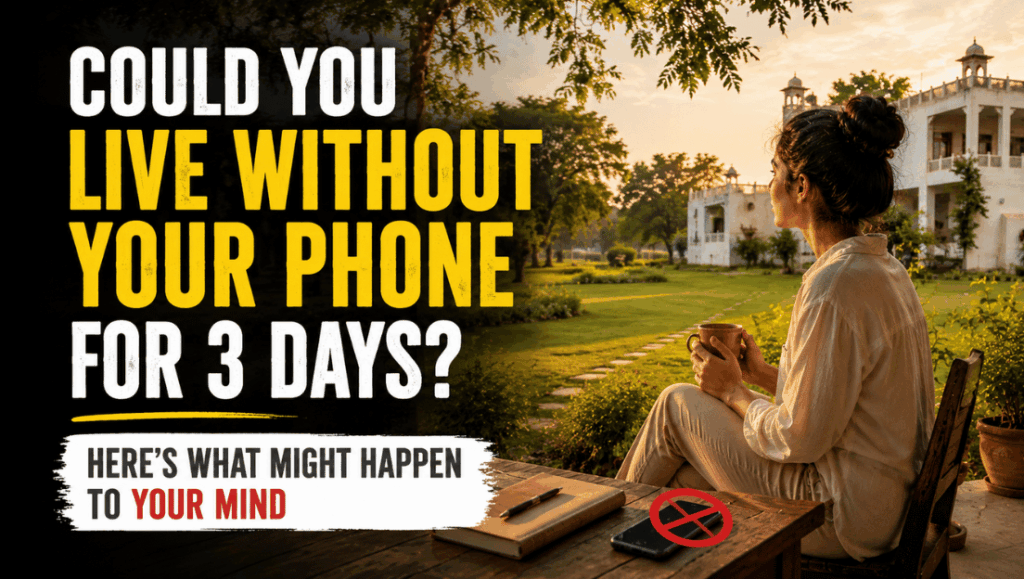
Could You Live Without Your Phone for 3 Days? Here’s What Might Happen to Your Mind
The alarm rings. You pick up your phone to stop it. There is one WhatsApp message. You check it. Then an Instagram notification catches your eye. Then one reel. & Then another. You check the weather, open your email, perhaps skim some news. Suddenly, twenty minutes have passed. You have not even left your bed. Now here is the question worth sitting with: what would happen if, for just three days, you stopped giving your phone access to every empty moment of your life? No Instagram. No endless reels. & No checking notifications every few minutes. & No reaching for the phone simply because you are bored. Not forever. Just 72 hours. Could you actually do it? Before the Experiment: How Did We Get Here? Think about the ordinary moments of an ordinary day. The phone is there when the alarm goes off. It comes to the bathroom. It sits beside the plate during meals. & It is on during conversations, during television, during the lift ride between floors, during the two-minute wait in a queue that once simply required standing. None of these feel dramatic. Each one is a small, automatic reach. The hand moves before the mind decides anything. The phone is already open before any clear reason has been formed. We no longer reach for our phones only when we need them. We reach for them whenever life becomes quiet. That shift, from tool to default response to silence, is where this article begins. Why Is It So Difficult to Put the Phone Down? The answer is not weakness or poor self-discipline. It is design. Apps are built around the same psychological principle that makes gambling compelling: unpredictable rewards. Each swipe might bring something funny, something surprising, a message, a compliment, something that triggers a small surge of emotion. The brain responds to this unpredictability by staying alert, by keeping the thumb moving, because the next piece of content might be the one that actually satisfies. The problem is not that every piece of content is interesting. The problem is that the next one might be. Add to this the social validation of likes and replies, the constant novelty of new content, and the instant escape from boredom or discomfort that a phone provides, and you have a system that the human brain was not designed to resist without effort. Is Your Brain Actually Rotting? Brain rot is not a medical diagnosis. It is a term people use to describe a feeling, one that is increasingly common: mental fog, scattered attention, compulsive scrolling, and a growing difficulty engaging with anything that moves slowly. It shows up in recognizable ways: The question is not whether technology is causing permanent damage. The question is simpler and perhaps more honest: Have we become bored more easily, or have we simply forgotten how to be bored? The Hidden Cost of Never Being Bored Boredom was never just discomfort. It was also the condition in which the mind did its quieter work: daydreaming, reflecting, processing emotions, arriving at ideas that did not come from anywhere in particular. Now every tiny gap is immediately filled. Waiting for a friend? Scroll. Waiting for food? Scroll. Travelling? Scroll. Before sleeping? Scroll. The gaps have been sealed with content. We have eliminated boredom. But perhaps we have also eliminated some of the quiet spaces in which original thoughts appear. The 72-hour experiment is partly about putting the phone away. But it is also about finding out what returns when the gaps are allowed to exist again. The 72-Hour Experiment Here is what the three days might actually look like. Not the version from a wellness blog where everything becomes peaceful by lunchtime on Day One. The honest version. The First Few Hours: Where Is My Phone? The reaching starts almost immediately. Not because anything specific needs to be checked, but because the hand moves there automatically. There is a phantom sense that something is waiting, something is happening, something needs a response. This is the moment that reveals how deep the habit runs. The urge to check is not coming from need. It is coming from conditioning. And noticing that, feeling it clearly, is already the most useful thing the experiment offers. Day One: Boredom and Restlessness The first day is not magical. It is probably uncomfortable. There is boredom. There is restlessness. & There is the nagging sense that notifications are accumulating somewhere, that something is being missed. This is important to sit with rather than escape. Because the discomfort is honest. It shows exactly how much the mind has been outsourcing its regulation to a device. On the first day, you may not miss your phone. You may miss constant stimulation. Those are different things. Day Two: Attention Begins Returning to Real Life Something starts shifting. Breakfast takes longer and it is noticeable. Not because it changed, but because there is now enough attention available to actually be there for it. The exact experience varies. The point is not a particular discovery. The point is that things become visible when attention stops being constantly fragmented. Day Three: Life Starts Feeling More Spacious By Day Three, different rhythms have begun forming. The day feels different in a way that is hard to describe precisely but very easy to feel. Perhaps you did not need more hours in your day. Perhaps you needed fewer things interrupting the hours you already had. What Might Change After Three Days? This section should come with an honest disclaimer: three days will not rewire the brain. The goal is not transformation. It is observation. But observation, done carefully, can shift things. Why a Digital Detox at Home Can Be Surprisingly Difficult Here is the honest problem with trying this at home. At home, the Wi-Fi is always on. The charger is beside the bed. Work notifications continue arriving. The sofa is associated with scrolling because that is what happens on it every evening. Everyone around you may be using