
Sound Familiar?
- Alarm rings. You reach for your phone before you are even fully awake.
- 47 notifications. 3 urgent emails. A deadline you forgot.
- Chai in hand, scrolling. Commute. Office. Repeat.
- By noon, you are exhausted. And the day has barely started.
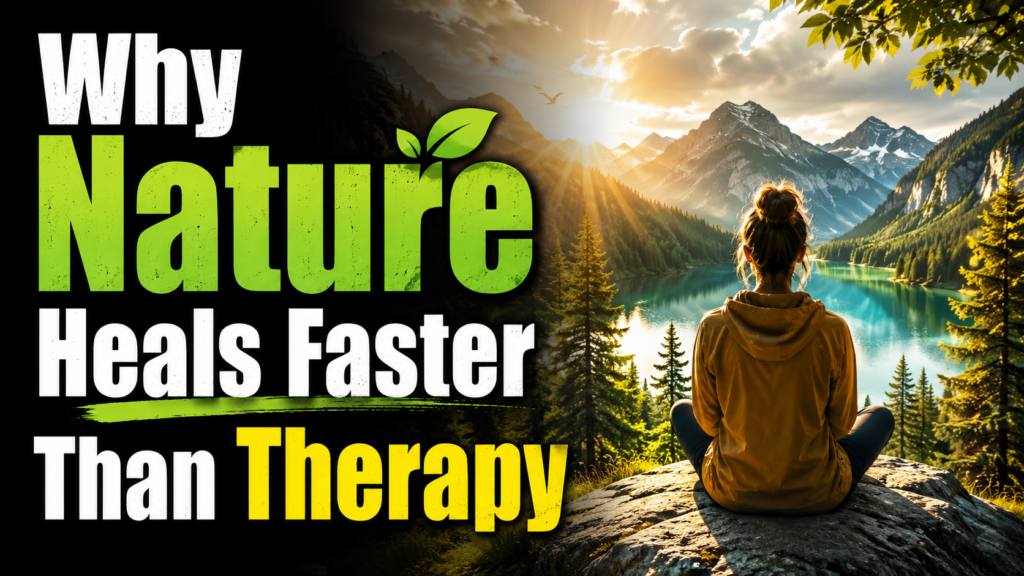
You have thought about therapy. Maybe even tried it. But something still feels off: tight chest, restless mind, a tiredness that sleep does not fix. What if the answer is not in a clinic? What if it has been outside, all along?
Nature is not a luxury. It is a necessity the modern world taught us to forget.
What Ancient Civilisations Already Knew
Long before psychiatry, human beings healed their minds with one simple prescription: time in nature. This was not superstition. It was lived science, tested across thousands of years and embedded in the medical traditions of civilisations that understood the human body as an extension of the natural world, not separate from it.
India: Ayurveda and Prakriti
Ayurveda, one of the world’s oldest healing systems at over 5,000 years old, begins with a radical premise: human beings are not separate from nature. They are made of the same five elements: earth, water, fire, air, and space. When a person falls ill, it is understood as a disconnection from natural rhythm. Healing, therefore, means returning to it.
The Charaka Samhita, one of the foundational texts of Ayurvedic medicine, prescribed what it called Vatavaran Chikitsa: treatment through atmosphere. This included time in forests, bathing in rivers, listening to birdsong, and walking barefoot on the earth. These were not supplementary suggestions. They were medical protocols, as seriously prescribed as any herb or formulation.
The practice of walking barefoot on soil, watching the sunrise, and bathing in natural water was understood to recalibrate the body’s relationship with the elements it was made from. The earth was not a backdrop to healing. It was the medicine.
Japan: Shinrin-Yoku and the Science of Forest Bathing
In 1982, Japan introduced Shinrin-Yoku as a national health initiative. The term translates simply as forest bathing, and the practice is exactly what it sounds like: spending slow, intentional time in a forest, without goal or destination.
The research that followed was remarkable. Just two hours in a forest environment measurably lowered cortisol levels, reduced blood pressure, and increased the activity of natural killer cells in the immune system. Scientists discovered that trees emit compounds called phytoncides, airborne chemicals that the human immune system responds to directly when inhaled. The forest was not merely a pleasant environment. It was a functioning pharmacy, and the human body had evolved to receive its medicine.
Decades of Japanese research have since confirmed that regular forest bathing reduces anxiety, improves sleep quality, lowers markers of chronic inflammation, and produces lasting changes in mood that persist well beyond the walk itself.
Ancient Greece: Landscape as Treatment
Hippocrates, considered the father of Western medicine, did not build his healing centre in a city. He chose a site surrounded by pine forests, fed by sacred springs, and open to sea breezes. This was a deliberate choice. He understood that the environment in which healing happened was not incidental to the treatment. It was part of it.
Hippocrates prescribed nature walks, sunlight exposure, and time in gardens for what he called melancholy, a condition that maps closely to what is now understood as depression. Greek healing temples, the Asclepieia, were consistently built near mountains, rivers, or the sea. The natural landscape was not an aesthetic backdrop. It was recognised as an active element in the restoration of the mind.
Why Nature Heals What Therapy Sometimes Cannot
Therapy is valuable. It creates space for reflection, provides tools for understanding patterns, and offers genuine support for people navigating difficult experiences. But it works primarily through language and thought. It operates at the level of the conscious mind, using words to process what has happened and reframe how it is interpreted.
Nature works differently. It works directly on the body, below thought, before words. And this distinction matters enormously for a particular kind of modern suffering: the chronic, low-grade stress and exhaustion that accumulates not from trauma or crisis, but from the sustained pressure of ordinary contemporary life.
- The body, not just the mind, holds stress. Elevated cortisol, shallow breathing, chronic muscular tension, disrupted sleep: these are physical conditions. Nature resets all of them without requiring any conscious effort or insight.
- There is no judgment and no agenda. The trees do not care about the inbox or the past. That complete indifference is profoundly freeing to a nervous system that has spent years performing, producing, and proving.
- It restores natural rhythm. Modern life is deeply arrhythmic: artificial light disrupts sleep, irregular meals confuse digestion, constant stimulation prevents the nervous system from ever fully resting. A few days in a genuinely natural environment recalibrates the circadian clock and, with it, sleep quality, digestion, and mood.
- Silence is a nutrient. Not the silence of a quiet room, but the living silence of nature: birdsong, wind through leaves, the distant sound of water. The human nervous system evolved to recognise these sounds as signals of safety. It relaxes in their presence in ways it cannot achieve indoors, regardless of how quiet the room.
- Perspective arrives without words. Sitting beneath a vast Rajasthani sky filled with undimmed stars and genuinely feeling its scale, the weight of personal worry shifts. Not because the problems have been solved, but because the sense of proportion returns. The person remembers, in the body rather than in the mind, that they are part of something much larger than any deadline or difficulty.
This is what ancient healers understood intuitively and what modern research is now confirming in precise physiological terms. The natural world is not a pleasant addition to recovery. For a growing number of people, it is the recovery.
Coming Home: At Off Grid Rajasthan
Off Grid Rajasthan is not a luxury resort or a wellness clinic. It is a farmstay, family-owned and family-run, built on the belief that the most powerful healing happens quietly, when a person is simply placed in the right conditions and allowed to breathe.
Located in the open countryside of Village Mangalwa, Bansur, far from city noise and artificial light, the farm operates on a different rhythm entirely. The day is shaped by sunrise and soil rather than schedules and screens. What awaits is not a programme to complete but a pace to settle into.
- Sunrise over open Rajasthani countryside, with no city noise and no traffic
- Farm-fresh organic meals grown in the soil surrounding the farmstay
- Hydroponic farming, organic cultivation, bonsai, and vermiculture, to reconnect with where food actually comes from
- Stargazing under skies unpolluted by city light
- Nature walks through the surrounding Rajasthani countryside
“You don’t need to fix yourself before you come. The land will do much of that work for you.”
Plan your stay at Off Grid Rajasthan
www.offgridrajasthan.com
Start Today: Nature’s Daily Protocols
A stay in the countryside is a powerful reset, but the wisdom of ancient healers does not require a journey to access. These practices are simple, free, and supported by both traditional medicine and modern research. They can begin anywhere, today.
- Barefoot grounding: 20 minutes daily on natural earth. Measurably reduces inflammation, improves sleep onset, and lowers cortisol levels.
- Sunrise witnessing: stepping outside within 30 minutes of waking. Sets the circadian clock for the entire day, improving energy, focus, and sleep quality.
- Forest bathing: 20 minutes in any green space, phone in pocket, no podcast, no agenda. Just presence. The benefits begin within minutes.
- Digital sunset: no screens after 8 PM. This single change allows the nervous system to begin its natural wind-down, improving sleep depth significantly.
- Moon tracking: noticing the moon each evening. A simple, ancient practice that reconnects daily life to natural time and restores a sense of rhythm that modern schedules often destroy.
None of these require equipment, expense, or expertise. They require only the willingness to pause, step outside, and remember that the natural world is not separate from life. It is the foundation of it.
The Invitation
Human beings evolved under open skies. In forests and on plains. With hands in soil and eyes on horizons, watching the seasons turn and the stars wheel overhead. For the vast majority of human history, proximity to the natural world was not a lifestyle choice. It was simply life.
The disconnection from nature that defines modern urban existence is historically new. And while it has brought extraordinary conveniences and capabilities, it has also introduced a chronic biological stress that the human body does not know how to name, only how to feel. The tight chest. The restless sleep. The sense of running constantly without moving anywhere.
The ancient healers of India, Japan, and Greece understood something that modern medicine is slowly rediscovering: the natural world is not a pleasant background to human life. It is a necessary part of human health. The forest is a pharmacy. The earth is a reset. The open sky is a perspective that no therapy room can fully replicate.
Nature heals. She has been doing it for billions of years. She is very good at it.
Come. Step off the grid. Let the earth remember you.
Off Grid Rajasthan
Farmstay · Organic Living · Nature Retreat · Rajasthan