
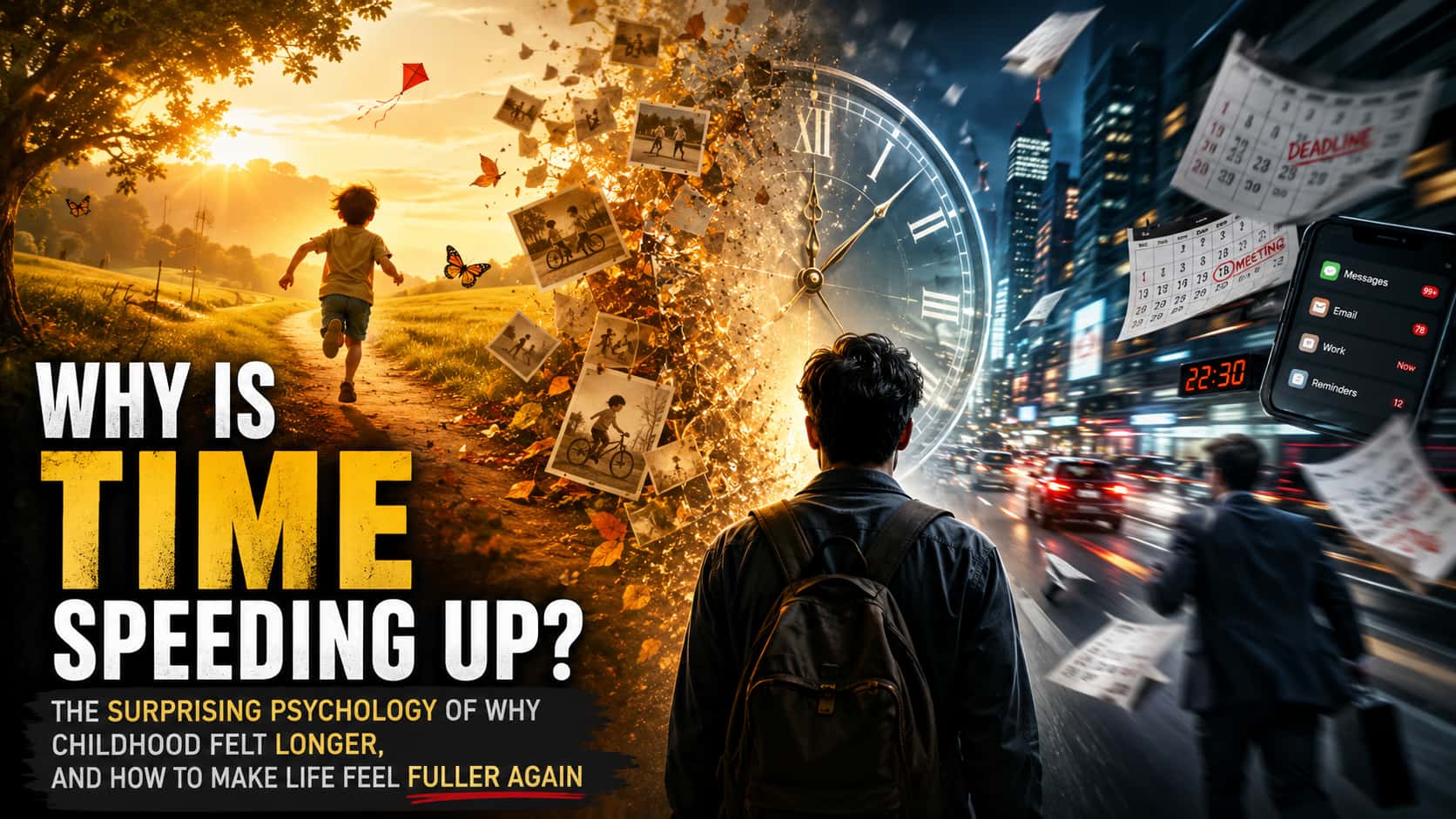
The Surprising Psychologyof Why Childhood Felt Longer, and How to Make Life Feel Fuller Again
Wasn’t it just January?
How is it already someone’s birthday again? Didn’t we celebrate Diwali only a few months ago? How is that child already ten years old? How has it been five years since that trip?
We were children once. A summer vacation felt enormous. Waiting one month for a birthday was almost impossible. A single school year felt like a whole chapter of life, long enough to contain entire friendships, discoveries, and versions of yourself.
Now Monday becomes Friday. January becomes June. One birthday follows another so quickly that the cards barely have time to feel sentimental. Entire years seem to disappear quietly, leaving behind only the faint impression that something was supposed to happen in them.
The clock still has the same 24 hours. So why does time seem to move faster as we grow older?
First: Is Time Actually Moving Faster?
Obviously not. A minute is still a minute. A year still contains 365 days, each with 24 hours. The calendar has not changed.
What has changed is how we experience time. And our experience of time is not measured by clocks. It is shaped by attention, memory, routine, novelty, emotional intensity, and how present we are while living through it.
There is a useful way to think about this. We experience time twice: once while living it, and again while remembering it. These are two different experiences, and they follow different rules.
The rate at which moments feel distinct is what determines whether a period of life feels rich or compressed, long or gone. And that rate is something we have more influence over than we might think.
Why Childhood Felt So Long
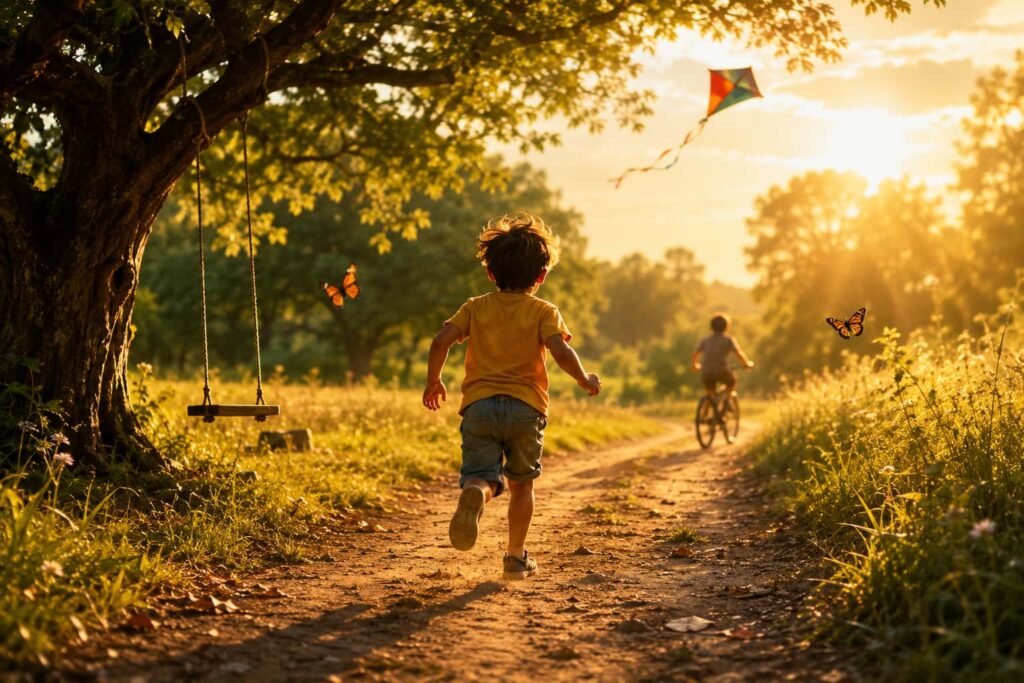
Think about childhood. The first day of school. The first long train journey and the countryside passing the window. & The first time seeing the sea and not quite believing it was real. Learning to ride a bicycle through a progression of falls and corrections that felt enormous at the time. Sleeping at a cousin’s house and the particular strangeness of an unfamiliar ceiling in the dark.
Summer holidays at grandparents’ homes, where a week contained more distinct experiences than a month of ordinary life. Climbing a tree and understanding the world differently from the height. Seeing a peacock unexpectedly and the sharp attention that unexpected beauty produces.
Almost everything was new. And new experiences demand attention. A child does not already know what is going to happen next, which means the mind has to stay alert, engaged, and actively processing. That state of active processing creates more distinct memories.
When life contains many new experiences, the mind creates more distinct memories. Looking back, that period feels richer and longer, because it was rich. It contained more moments that registered.
Childhood summers did not have more hours. They had more firsts. More moments when the world was surprising enough to demand full attention. That attention is what created the feeling of length.
The Routine Problem: When Every Day Starts Looking the Same
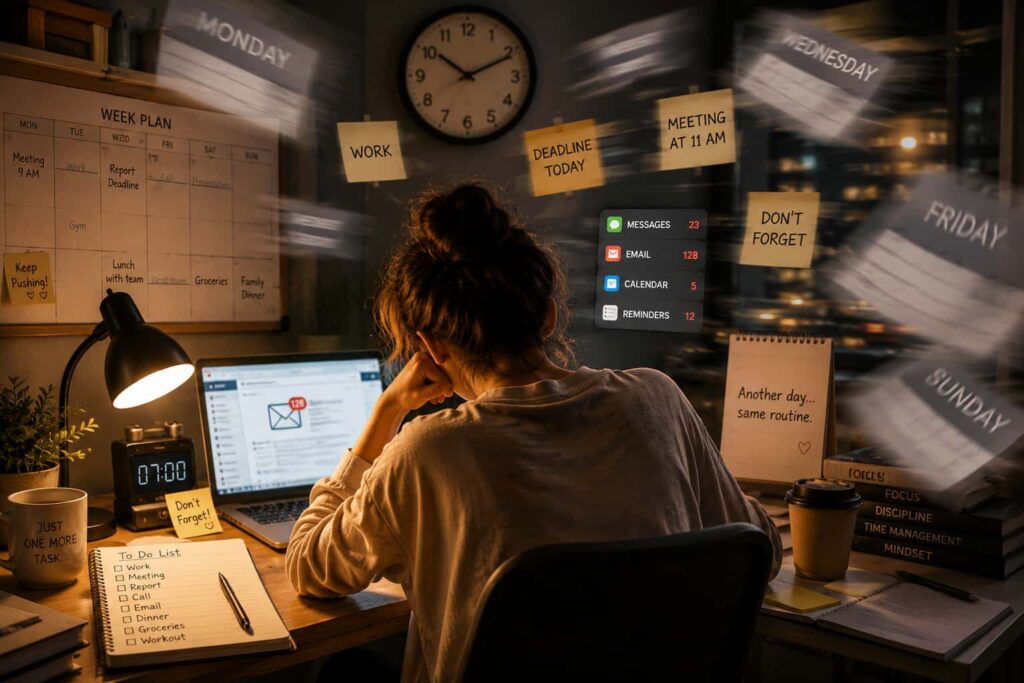
Consider a typical adult week. Alarm. Bathroom. Phone. Breakfast eaten quickly. Traffic or commute. Office or laptop. Lunch at the same time, often at the same place. More work. Traffic again. Dinner. Scrolling. Sleep. Repeat.
Nothing is necessarily wrong with routine. Routine allows life to function. It reduces decision fatigue. It provides structure. But when weeks contain very few distinct moments, they begin to blur together in memory.
Think about the last seven days. Can you clearly remember what you did on each one? Or do several of those days feel like one long Monday?
This is the routine problem. The days may feel busy and even exhausting while we are living them. But in memory, they compress. They contain few moments that the mind marked as distinct, which means they leave few traces.
An exhausting month can feel like it disappeared, not despite how much happened in it, but because so little of what happened was new enough to create a separate memory.
The Attention Problem: We Are Everywhere Except Where We Are
Even when something different is happening, the question is whether we are actually there for it.
At dinner, thinking about tomorrow. On vacation, answering emails. At a concert, recording it. Watching a sunset through a phone camera. Playing with children while checking messages. Walking with a podcast in one ear and a work problem in the background of every thought.
Attention is constantly divided. And divided attention creates thin memories.
Perhaps time isn’t always moving too quickly. Perhaps our attention is moving too quickly to notice it.
An experience lived with partial attention leaves a partial impression. The memories that last decades are almost always ones in which we were fully present: completely absorbed, all senses engaged, genuinely there. Those are not the moments we remember because they were dramatic. They are the moments we remember because we were actually inside them.
Why Photographs Don’t Always Mean Memories
We document more than any generation before us. Thousands of photographs. Hundreds of videos. Stories, reels, cloud backups, albums organized by date. And yet sometimes we barely remember the actual moment.
Because documenting an experience and deeply experiencing it are not always the same thing. You are watching a beautiful sunset. Instead of staying with how the colours change from orange to violet to the particular blue that comes just before dark, you spend ten minutes finding the right angle, adjusting exposure, making a video, choosing a song for the background, and uploading it.
You have saved the sunset. But did you actually see it?
The photograph proves you were there. The memory requires that you were actually present.
Why Busy Years Can Feel Surprisingly Short
People often expect busy years to feel long. So much is happening. So much is being done. Surely that should feel like a lot of time.
But busyness and richness are different things. A day containing thirty emails, eight meetings, fifty notifications, and two hours of scrolling may contain enormous activity. It contains very few distinct, memorable experiences.
A full calendar does not always create a full memory. The mind does not remember busyness. It remembers moments that stood out.
Repetitive activity, however demanding, compresses in memory because the mind stops marking each instance as distinct. It has seen this before. It files it under the same category as everything similar that came before. The day joins the long record of days that look like each other, and the year quietly ends with less to show for it in memory than in effort.
The Good News: You Cannot Slow Time, But You Can Change How You Experience It

This is where it matters to be honest. No technique will make one hour become two. Time itself cannot be stretched.
But the experience of time, the feeling of living a full life rather than watching it pass, can be genuinely changed. Not through grand gestures or dramatic overhauls. Through small, consistent shifts in what we pay attention to and how we structure the days we already have.
The goal is not to make one hour become two. It is to make one hour feel inhabited.
Seven Ways to Make Life Feel Fuller Again
1. Do Something New Regularly
Novelty creates distinct memories, and distinct memories create the feeling of a richer, longer life. It does not require international travel. A new walking route, cooking something unfamiliar, visiting a place that has never been visited, spending a weekend in a different environment: these small departures from routine create the separation between days that makes each one rememberable.
2. Stop Multitasking Through Beautiful Moments
If you are drinking tea, drink tea. If you are speaking to someone, listen. & If you are watching a sunset, watch it. Not every experience needs a second activity attached to it. The moments that become memories are the ones we gave our full attention to, even briefly.
3. Create Small Adventures
Adults often wait for annual holidays to create memories. But a Sunday morning nature walk can become a memory. A family picnic can become a memory. A night spent stargazing somewhere dark can become a memory. A rainy afternoon in a place never visited before can become a memory. Adventures do not require flights or planning. They require novelty and attention.
4. Spend Time Away From Screens
Not because technology is bad, but because uninterrupted attention helps experiences register more deeply. A conversation held without phones nearby is remembered differently from one where both people were half-elsewhere. A meal eaten without a screen running in the background creates a more complete impression. The experience can only become a memory if the mind was fully present for it.
5. Reconnect With Nature
Nature is constantly changing, but slowly enough for us to actually notice the change. Morning light shifts across a field over thirty minutes. Birds appear and disappear with the hours. Clouds move and reform. Seasons shift the colour of every living thing. A sunset unfolds over twenty minutes if you stay through all of it. Nature brings us back into direct sensory experience: sight, sound, touch, smell, the feel of real ground underfoot. It offers something that screens cannot, which is the quality of being genuinely surprised by the physical world. And that quality of surprise, of noticing something real, is what makes moments register as distinct.
6. Create Rituals, Not Just Routines
A routine is: drink tea at seven in the morning. A ritual is: sit outside, drink tea slowly, watch the morning light arrive, and say something to someone you love before the day asks anything of you. Same activity. Completely different experience. The ritual is intentional. It asks for presence. It creates a memory that the routine does not.
7. Collect Experiences, Not Just Evidence of Experiences
Photographs are not the enemy of memory. But perhaps take one good photograph and then put the phone away. Give the moment a chance to become something that lives in you rather than something that lives in a cloud storage folder. The evidence that you were somewhere is not the same as the memory of being there.
An Experiment: Can You Make One Weekend Feel Longer?
Here is something worth trying. For one weekend, do these things:
- Go somewhere unfamiliar, even if only a short distance from home
- Do not over-plan every hour
- Keep phone use genuinely minimal
- Wake with natural light rather than an alarm
- Eat slowly, without a screen present
- Walk somewhere without a destination or a podcast
- Stay for an entire sunset from beginning to end
- Have one uninterrupted conversation that lasts longer than thirty minutes
- Do at least one thing you have never done before
- End the day by writing down three things you noticed
Then ask honestly: did those two days feel different from another weekend spent running errands and scrolling between tasks? Did Sunday evening feel like there was more of the weekend in it than usual?
That feeling is not an accident. It is what happens when attention and novelty combine.
Maybe You Don’t Need More Time. Maybe You Need Different Time.
We often say, I wish I had more time. But perhaps what is really missing is time that feels different from everything around it.
A morning that does not begin like every other morning. A meal that is not eaten while looking at something else. A walk that has no destination. An evening where the sunset itself is the plan and nothing else needs to happen.
That quality of time is not a matter of quantity. It is a matter of how the time is inhabited.
Make a Weekend Feel Like a Memory Again

At Off Grid Rajasthan, we believe a meaningful break is not measured by how many activities are fitted into it. Sometimes it is measured by how deeply the simple things are experienced.
Waking to birdsong. Walking through open green Rajasthani countryside. Eating a slow farm-fresh meal prepared from soil you can see from the table. Sitting together without interruptions. Watching the sky change colour from a verandah with nowhere else to be. Looking up at stars that the city never shows you clearly.
These may sound like small moments. But these are often the moments we remember longest: the ones where we were fully present, the surroundings were genuinely different, and the pace allowed us to notice what was happening.
If your weeks have started blending into months, and your months into years, perhaps it is time to give yourself a few days that feel distinct from everything around them.
- Open countryside with no familiar habit cues or city noise
- Organic farm-fresh meals eaten slowly and without a screen
- Sunrise walks, barefoot ground, birdsong that rewards actual presence
- Stargazing under skies that have not been dimmed by the city
- A pace that creates memories rather than consuming hours
Plan your stay at Off Grid Rajasthan
Before Another Week Disappears
Childhood did not have more hours. It had more first times. More attention. More curiosity. & More moments we were fully inside, completely present for, genuinely surprised by.
We cannot become children again. The world is no longer new in the way it once was. But we can choose, more deliberately than we usually do, to put ourselves in situations where something is unfamiliar enough to demand full attention. Where the surroundings are alive and changing and worth noticing. Where the pace is slow enough for the mind to actually register what is happening.
We cannot slow the clock. But we can fill the hours with things that the mind will still be able to find, years from now, when we look back.
When was the last time you did something that made one ordinary day feel unforgettable?
That day is available. It just has to be chosen.
Farmstay · Organic Living · Nature Retreat · Rajasthan