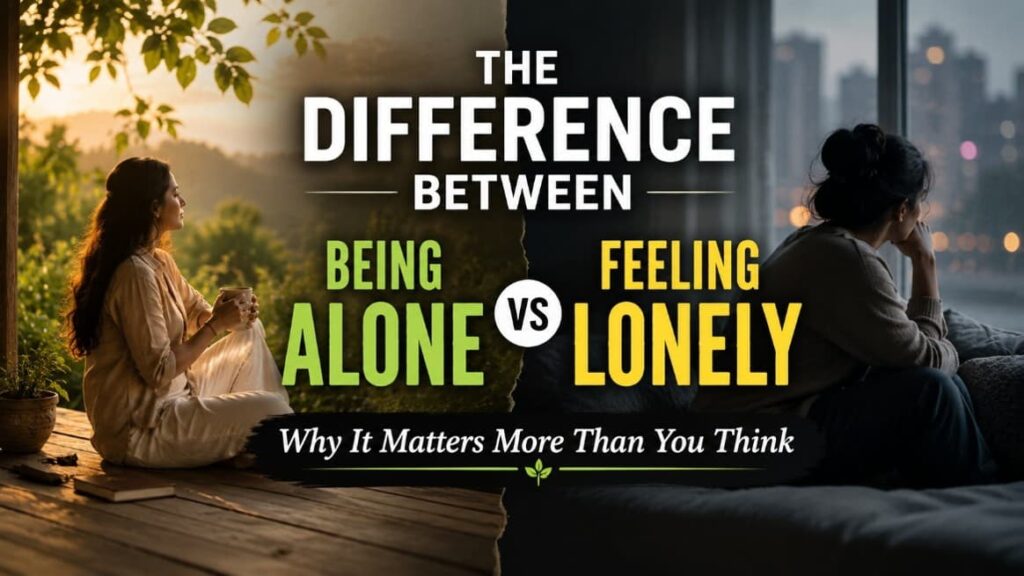
The Difference Between Being Alone and Feeling Lonely
Why Solitude Can Heal You While Loneliness Can Hurt, and How Nature Helps You Rediscover Yourself Quick Answer Being alone describes a physical situation: the absence of other people. Loneliness is an emotional experience: the feeling of being disconnected, unseen, or unheard, regardless of how many people are nearby. Solitude, when freely chosen, can support reflection, creativity, and emotional renewal. Research consistently shows that meaningful relationships remain essential to well-being, and that time in nature can meaningfully support emotional health alongside human connection. Have You Ever Felt Lonely in a Crowded Room? Picture a family gathering. The room is full. There is food, there is noise, there are people who have known each other for decades. And yet, somewhere in the middle of it, a person can feel profoundly, quietly alone. Not because nobody is speaking to them. But because nobody is quite seeing them. Or consider the open-plan office. Desks close together, conversations overlapping, a constant hum of activity. A person can sit in the middle of all of it and feel invisible, present in the room but absent from it in some deeper way that is hard to name. Then there is the scroll. Late at night, phone in hand, moving through image after image of other people’s lives, other people’s celebrations, other people’s ordinary Tuesdays. A person surrounded by digital connection, feeling more alone with every swipe. How can someone be surrounded by people and still feel lonely? The answer lies in a distinction that is simple to state and surprisingly easy to lose sight of in the middle of modern life. Being alone and feeling lonely are not the same thing. Understanding the difference between them may be one of the most quietly important things we can do for our emotional well-being. What Does It Mean to Be Alone? Being alone is simply a circumstance. It describes a physical situation: the absence of other people in the immediate environment. And on its own, that circumstance is neither good nor bad. It is neutral. What shapes the experience is not the aloneness itself, but how it is felt. Many people describe their most peaceful moments as ones spent alone: reading in a quiet room on a rainy afternoon, tending a garden in the early morning, walking through an open landscape with no particular destination, sitting with a cup of tea and watching the light change. These are moments of solitude. They are chosen, comfortable, and genuinely nourishing. Solitude is aloneness that has been inhabited rather than endured. It is the state of being with oneself in a way that feels like company rather than abandonment. Writers and artists have sought it deliberately for centuries. Scientists, philosophers, and spiritual traditions across cultures have recognized it as a condition necessary for a particular kind of thinking and feeling that crowds cannot accommodate. Being alone is about where you are. Solitude is about how you feel while you are there. Chosen solitude is not a withdrawal from life. It is a particular way of engaging with it: slower, quieter, and turned inward in ways that the presence of others often makes impossible. What Is Loneliness? Loneliness is not about the number of people present. It is about the quality of connection, or more precisely, the felt absence of it. A person can feel lonely in a marriage where conversations have thinned into logistics. In a classroom where nobody quite understands them. In a family where love is present but real understanding is rare.& In an office full of colleagues with whom the relationship stays permanently on the surface. Loneliness is the experience of feeling unseen, unheard, or disconnected from the people around us, regardless of their physical proximity. It is the gap between the connection we have and the connection we need. Social media makes this particularly complex. Online, a person can have hundreds of followers, post regularly, receive comments and reactions, and still feel profoundly alone. Because the interaction, however frequent, does not carry the weight of genuine presence. It is connection that satisfies the eye but not the deeper need for being truly known. Why Are So Many People Feeling Lonely Today? Loneliness is not a new human experience. But its scale in the current moment is drawing serious attention. The World Health Organization has identified social isolation and loneliness as significant concerns for global health. The U.S. Surgeon General’s 2023 advisory on loneliness described it as an epidemic with measurable consequences for physical and mental well-being. Several features of modern life appear to be contributing to this. Remote work has removed the incidental human contact that offices once provided: the brief exchange in the corridor, the shared lunch, the small moments of presence that were never dramatic but were, it turns out, meaningful. Busy schedules leave little room for the slow, uninterrupted conversations that create genuine closeness. Families are smaller and more geographically dispersed. People move more often and build community less easily. And then there is the particular dynamic of constant digital connection combined with reducing face-to-face depth. Notifications arrive continuously, but they rarely ask for the kind of sustained, undivided attention that makes another person feel truly received. We have never been more connected digitally, yet many people feel less connected emotionally. The two kinds of connection are not interchangeable. The Science Behind Loneliness Research consistently shows that meaningful social connection is important to human well-being. Studies published in journals including the American Journal of Psychiatry and findings referenced by the American Psychological Association indicate that prolonged loneliness is associated with elevated stress, disrupted sleep, and reduced sense of purpose and belonging. Loneliness activates the brain’s threat response in ways that are similar to physical pain: the body treats social disconnection as something requiring attention and resolution. This is not a personal weakness. It is the predictable response of a social species to the felt absence of the connection it was built for. It is important to note that these findings describe patterns across