
Simple Rituals That Help Families Slow Down, Reconnect, and Create Memories That Last a Lifetime
Quick Answer
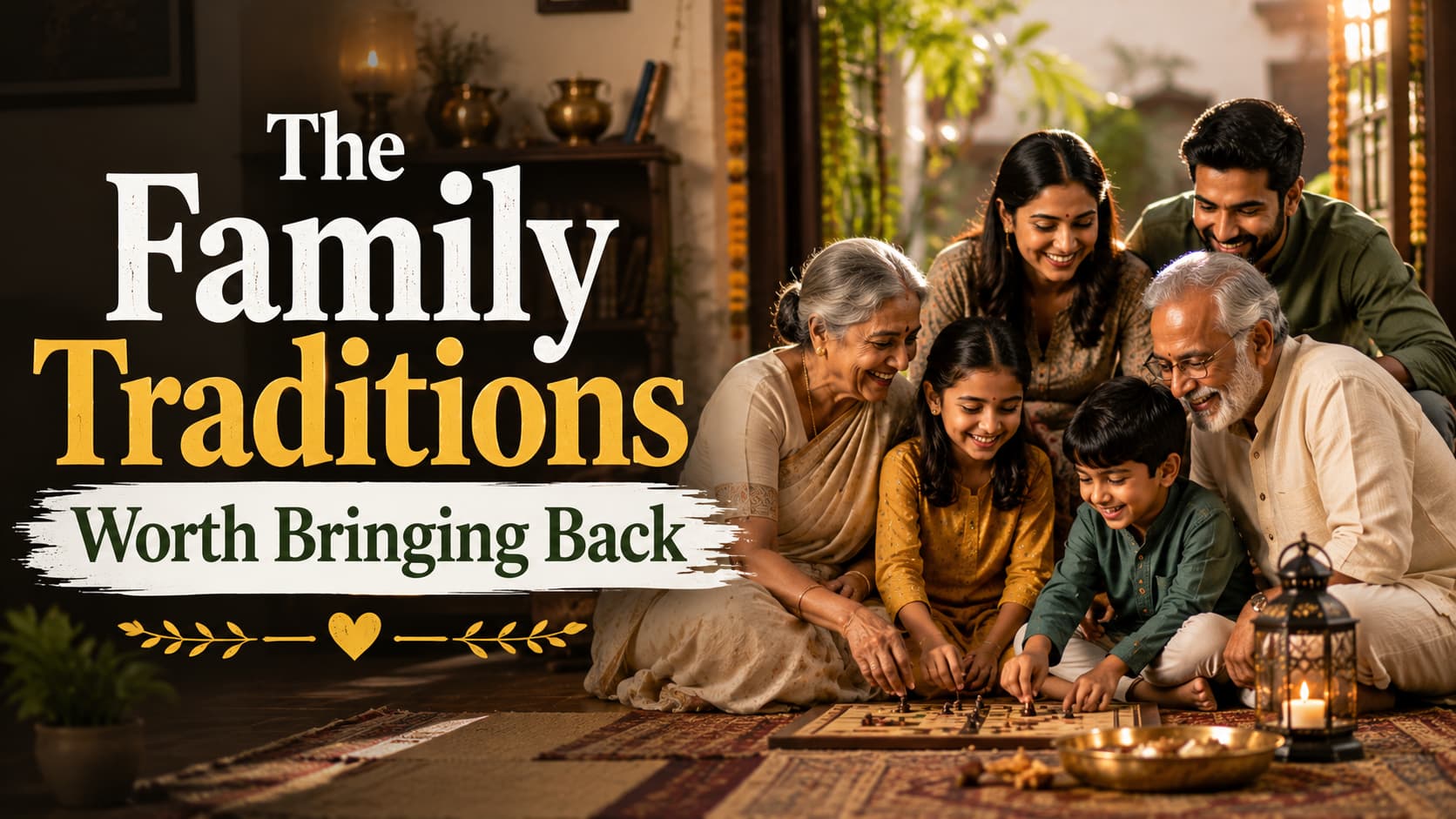
Simple, repeated family rituals, such as eating meals together, walking, storytelling, cooking, and spending time in nature, can strengthen emotional bonds, create lasting memories, and provide children with a sense of belonging and security. Research suggests that consistent family routines contribute meaningfully to children’s emotional well-being and a shared sense of family identity across generations.
When Did Family Time Become So Busy?
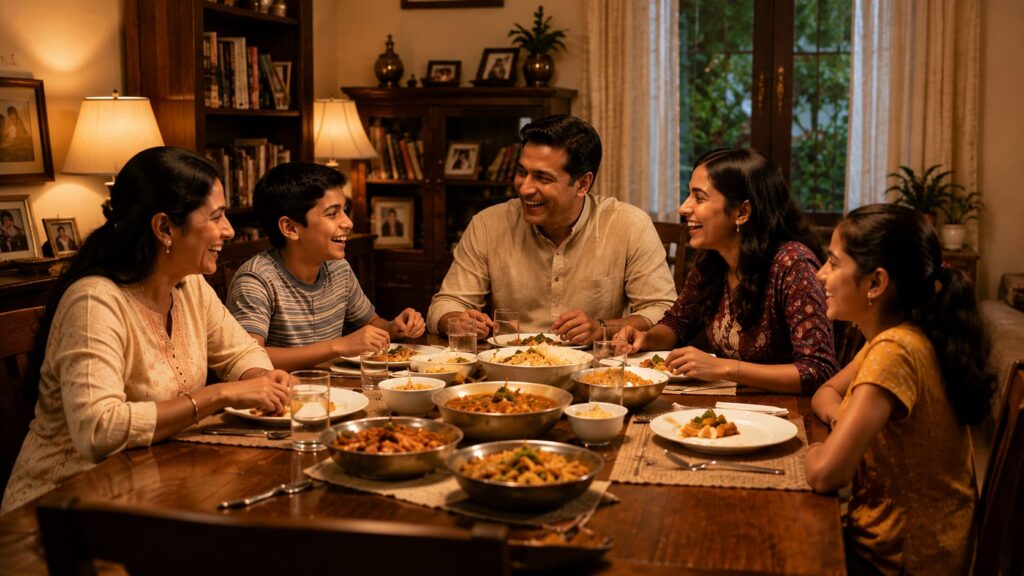
Picture the dinner table from twenty years ago. Not a special occasion. An ordinary Tuesday. Food in the middle, everyone seated, voices overlapping, somebody laughing about something that happened during the day. No phones. Nobody performing for an audience. Just the unremarkable, irreplaceable quality of people who love each other being present in the same room at the same time.
Now picture the table today. Perhaps everyone is there. Perhaps the food is even better. But the phones are also there, face down or face up depending on who is trying harder. Someone is half-watching something. Someone is replying to a message. The conversation is briefer and more interrupted. And the particular quality of that older table, the full presence, the unhurried exchange, is harder to find.
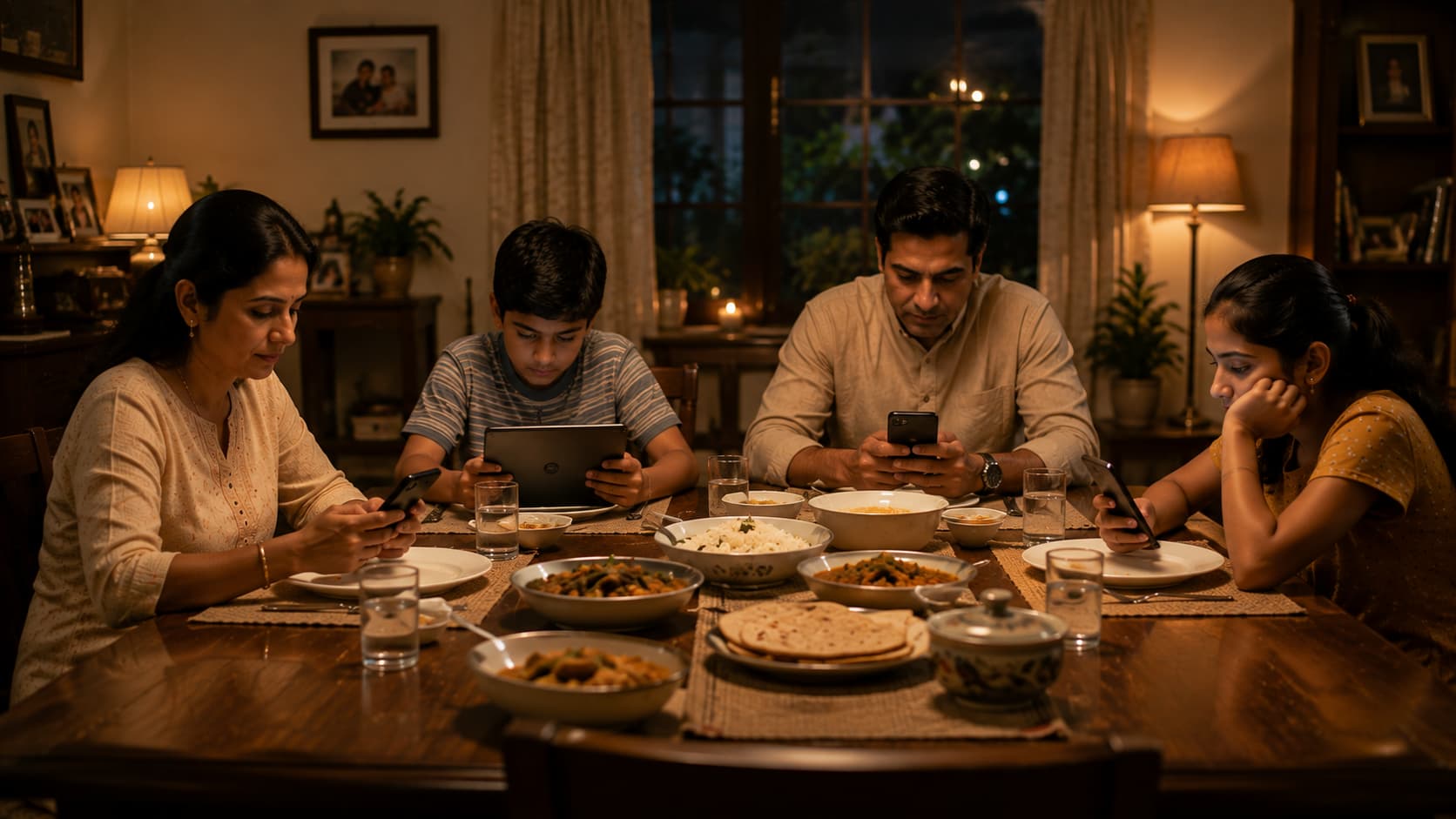
When was the last time your family spent an evening together without anyone looking at a screen? Not because screens were forbidden, but because nobody needed one?
Modern life has quietly changed many of the small rituals that once brought families together. Not through bad intention, but through accumulated busyness, individual schedules, and the infinite availability of private entertainment. Togetherness has not disappeared. But real connection, the kind that builds slowly through repeated ordinary moments, has become something that requires more deliberate effort than it once did.
Family Traditions Were Never About Big Celebrations
Many of us grew up with small traditions we barely noticed at the time but deeply appreciate now. The evening walk after dinner that was simply what the family did. The Sunday lunch that was not discussed or scheduled but simply happened, reliably and warmly, every week. The grandmother who told the same stories every visit and somehow made them new each time.
Watching the first rain of the season from the front door, everyone gathered, nobody needing to explain why they had come. Flying kites on a rooftop on a particular day each year. Making tea together in the morning before the day asked anything of anyone. Cooking something slow on a winter afternoon, the kitchen warm and unhurried.
These traditions were not expensive. They did not require planning or coordination. They were simply repeated, with love and without much fanfare, until the repetition itself became the point.
Traditions are not remembered because they were grand. They are remembered because they were repeated with love.
Research from the Harvard Graduate School of Education and the American Psychological Association suggests that regular family routines, including shared meals, bedtime rituals, and consistent family activities, are associated with greater emotional security in children, stronger communication within families, and a more developed sense of belonging. These are not small things. They are the foundations on which a child’s understanding of home is built.
Why Have These Simple Rituals Quietly Disappeared?
Not through neglect. Not through lack of love. Modern life has simply reorganized itself in ways that make the old rhythms harder to sustain.
Work schedules stretch longer. Commutes eat into evenings. Children’s activities are more structured and more numerous than they once were. Individual screens offer each family member their own private world of entertainment, available at any moment, requiring nothing from anyone else in the room. Social media provides the sensation of connection without the effort of actual presence.
The result is not a family that has stopped caring. It is a family whose shared time has been quietly fragmented by the demands and distractions of a world that was not designed with shared family time in mind.
Recognizing this is not about blame. It is about noticing what has shifted, and asking whether some of what has been set aside is worth deliberately reclaiming.
What We Lose When Family Rituals Disappear
The Child Mind Institute and UNICEF both recognize the importance of consistent family time and meaningful parent-child interaction for healthy emotional development. Studies on family routines consistently find that children who experience regular, predictable shared time with family tend to show greater emotional resilience, stronger communication skills, and a more stable sense of who they are and where they belong.
This makes intuitive sense. A child who knows that Sunday mornings mean something particular with the people they love, who can count on the walk after dinner or the story before bed, is a child whose world contains reliable anchors. Those anchors do not prevent difficulty. But they provide something to return to when difficulty arrives.
Beyond the research: ask any adult what they remember most clearly from childhood, and the answer almost never involves a specific gift or a one-time extravagant experience. It involves the texture of ordinary days: what the house smelled like, what the family said at the table, who was always there, what always happened at a particular time of year.
Children rarely remember every gift they received. They remember how home felt.
When family rituals disappear, what is lost is not the activity itself. It is the shared vocabulary of small, repeated moments that gives a family its particular character, its particular warmth, its identity as this family rather than simply a group of people who live in the same house.
10 Family Traditions Worth Bringing Back
1. One Meal Together Every Day
Why it matters: Research on family meals is remarkably consistent: families who eat together regularly report stronger communication, greater emotional closeness, and children with better mental health outcomes. The meal itself matters less than the uninterrupted time it creates.
How to start: Choose the meal that is most realistic for your family’s schedule. It does not have to be dinner. Even breakfast together, without phones, counts.
One tip: Make it phone-free by default. A basket on the counter works better than a rule.
2. Screen-Free Sunday (or Any One Day)
Why it matters: One screen-free day per week creates a different quality of family time: slower, more conversational, more creative. Children often discover, with some initial resistance, that they are quite capable of entertaining themselves and each other.
How to start: Start with a morning rather than a full day. Build from there as the family finds its rhythm.
One tip: Plan something together for the morning so the day has shape: a walk, cooking, a game, anything.
3. Evening Walks Together

Why it matters: Walking side by side creates a particular quality of conversation: easier, less pressured, and more honest than face-to-face. Many families find that the best talks happen on the move.
How to start: A walk after dinner, even fifteen minutes, becomes a tradition within a few weeks of consistency. No destination needed.
One tip: Leave the phones at home, or at least in pockets. The point is the walking, not the steps.
4. Watching a Sunrise or Sunset Together
Why it matters: A sunrise or sunset is one of the few events that demands nothing from the people watching it except presence. It unfolds on its own schedule, cannot be paused or replayed, and rewards attention in a way that most screens cannot match.
How to start: Choose one morning or evening each week or month. Make it an occasion without making it complicated.
One tip: Bring something warm to drink. The comfort makes it easier to stay through the whole thing.
5. Storytelling Nights
Why it matters: Stories are how families transmit values, history, and identity across generations. Children who hear family stories, including the difficult ones told with honesty and humor, develop a stronger sense of who they are and where they come from.
How to start: Start with a single prompt: tell me about when you were my age. Or: tell me about the day I was born. The stories will come.
One tip: Grandparents are often the richest source of family stories. If they are nearby or reachable, include them.
6. Cooking Together
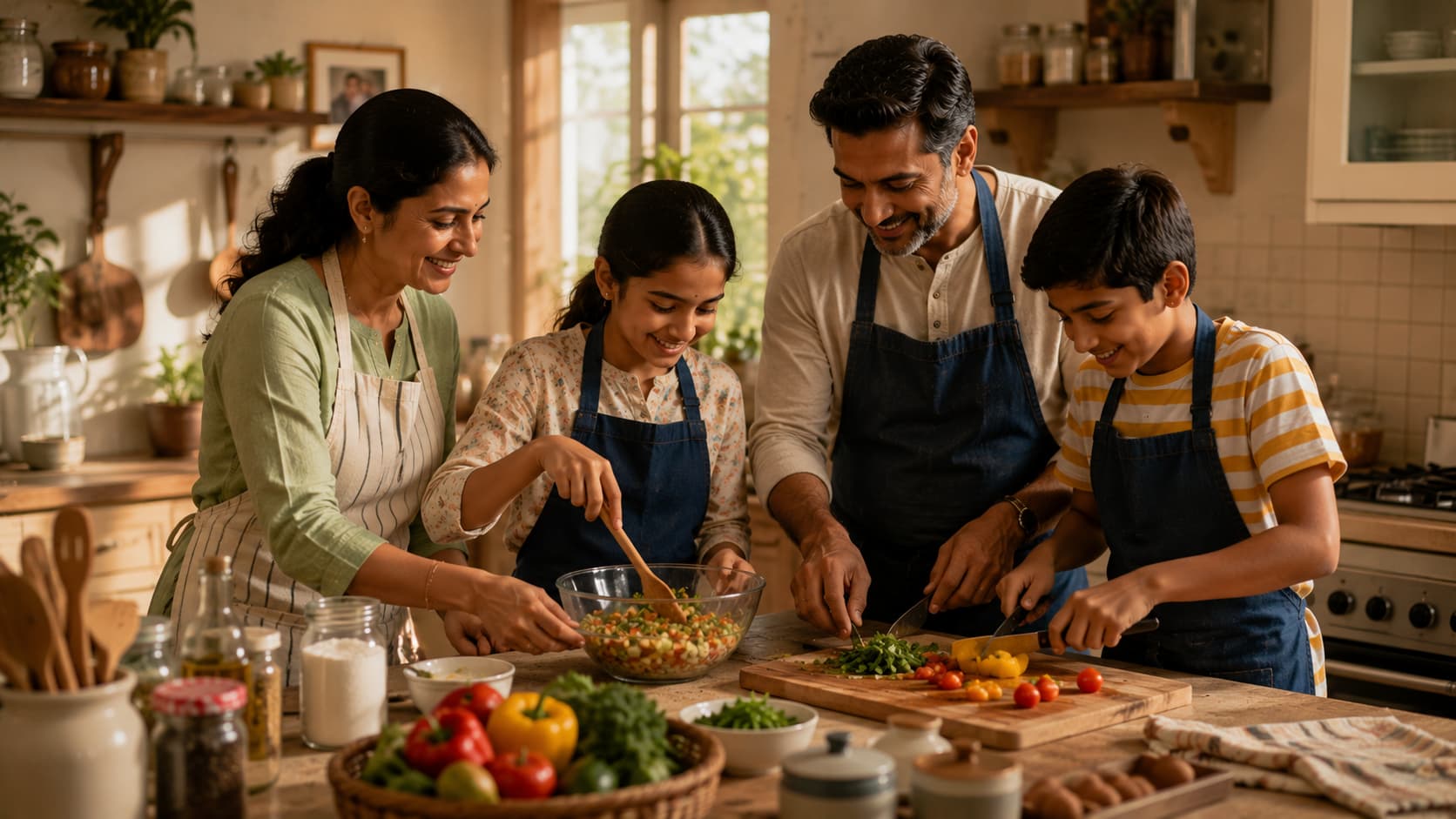
Why it matters: Cooking together is one of the most naturally educational family activities: it requires cooperation, patience, attention, and produces something everyone gets to enjoy. Children who cook with family develop practical skills, but more importantly, they develop the memory of standing in a kitchen with someone they love.
How to start: Give children real jobs, not decorative ones. Stirring, measuring, chopping age-appropriately, tasting. The participation is the point.
One tip: Choose a dish that matters to the family. A grandmother’s recipe. A seasonal specialty. Something with a story.
7. Celebrating Nature’s Rhythms
Why it matters: The first rain, the first mango of the season, a full moon visible on a clear night: these are events that families once marked instinctively and now often scroll past. Noticing them together creates a shared attention to the natural world that is both grounding and genuinely pleasurable.
How to start: Simply step outside when something notable is happening. Gather at the door when rain arrives. Go to the roof when the moon is full. The ritual is the gathering.
One tip: Let children lead the noticing. They are often better at it than adults who have learned to look past things.
8. The Family Picnic
Why it matters: A picnic removes the family from the usual environment and places everyone in a shared space with fewer exits. No one drifts to another room. The setting itself creates togetherness.
How to start: A garden, a park, a field, a rooftop: location matters less than the intention to be together without the infrastructure of home surrounding you.
One tip: Pack food everyone helped choose or prepare. The involvement creates investment.
9. Gratitude Before Dinner
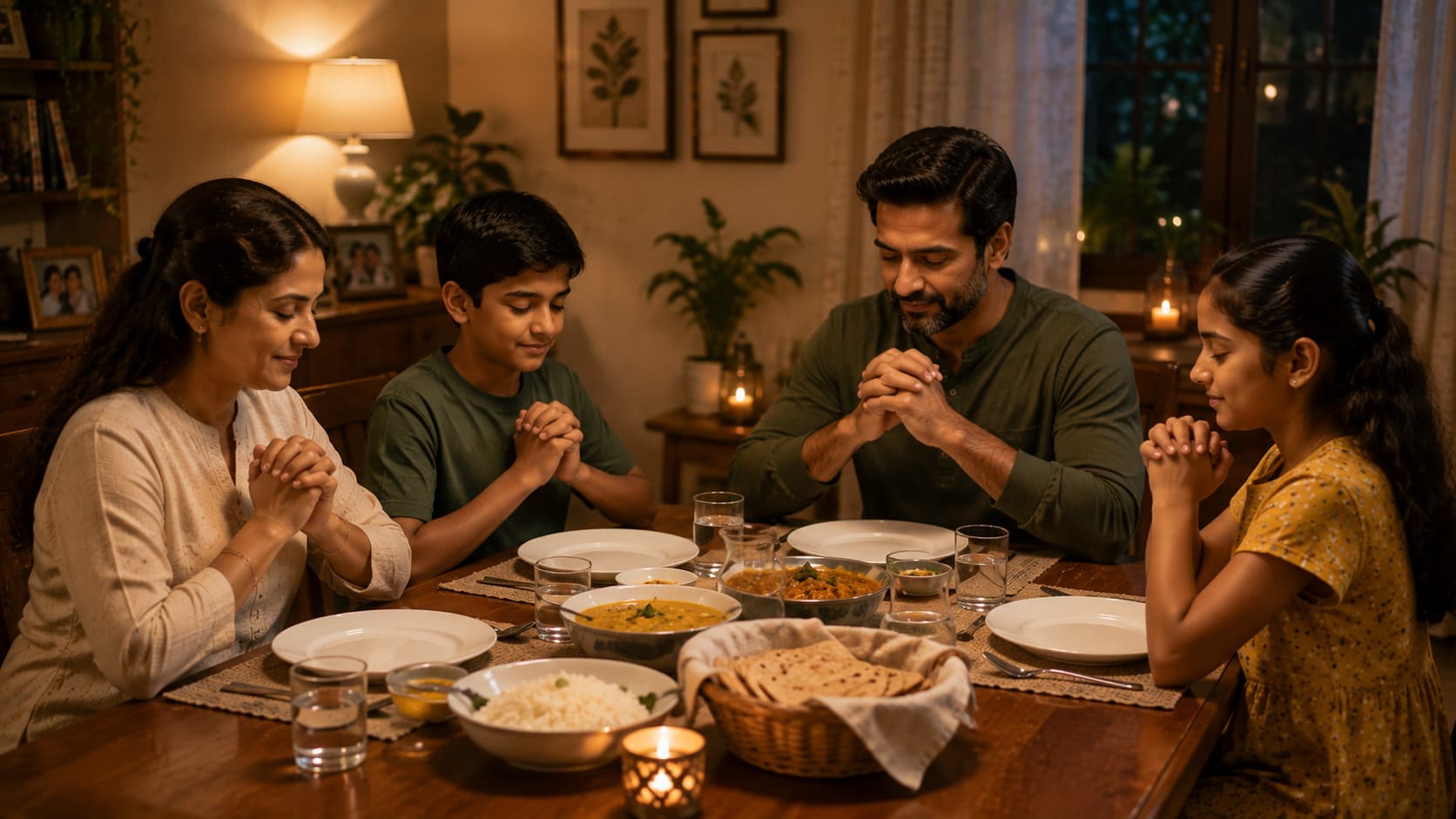
Why it matters: A moment of shared gratitude before a meal, whether spoken, written, or simply a brief pause, creates an opportunity for children to practice noticing what is good. Research on gratitude practices consistently finds associations with improved emotional well-being and greater satisfaction with daily life.
How to start: It does not have to be formal. One thing each person noticed today. Something they are glad about. Something they appreciated. Thirty seconds, every day, consistently.
One tip: Start with the adults. Children follow what they see modeled.
10. A Weekend in Nature Every Season
Why it matters: Changing the environment changes how families interact. Removed from home routines, individual screens, and separate bedrooms, families often find the conversations become longer, the games last more than one round, and the mornings feel worth waking up for.
How to start: It does not require international travel. An overnight in a different natural setting, four times a year, is enough to mark the seasons and create the distinct memories that a year’s worth of ordinary weekends rarely produces.
One tip: Leave the heavy planning behind. Arrive without an itinerary. Let the place set the pace.
Why Nature Brings Families Closer
There is something about natural environments that changes the quality of family interaction. Researchers have noted that time spent outdoors together tends to produce longer conversations, greater cooperation between siblings, and more relaxed adult behavior. The reasons are not mysterious.
Nature offers fewer distractions and more shared points of attention. When a bird lands nearby, everyone looks. When the light changes across a field, everyone sees it. & When it starts to rain, everyone responds to the same thing at the same time. These small moments of shared attention create the kind of togetherness that the separate screen does not.
Children become more curious outdoors. Adults become more patient. The physical movement, the sensory richness, and the absence of the usual environment all contribute to a different quality of presence. Studies on nature exposure and family well-being suggest that regular time in natural settings is associated with reduced stress in both parents and children, and with stronger family cohesion.
Nature gives families something modern life rarely offers: uninterrupted time together, with no inbox waiting and no other room to drift to.
The Family Memory Test: What Will Your Children Remember 20 Years From Now?
Not as a way of producing guilt, but as a genuine question worth sitting with:
- Will they remember another shopping trip, or the evening everyone stayed to watch the sunset and nobody wanted to leave?
- Will they remember the expensive toy that was exciting for a week, or making pakoras together while it rained outside and the kitchen smelled of spice?
- Will they remember another weekend at the mall, or the night the whole family slept outside and the sky was full of more stars than anyone had seen?
- Will they remember another hour on their individual screens, or the game that made everyone laugh until nobody could remember who was winning?
- Will they remember another ordinary Sunday, or the morning everyone woke early and walked through dew-wet grass to watch the sun rise over an open field?
Memory does not record the expensive or the elaborate. It records the moment of full presence: the specific light, the specific smell, the specific quality of laughter from a specific person on a specific evening that was, by most measures, entirely unremarkable.
Those are the moments. They do not happen by accident. They happen when a family is actually, completely, unhurriedly together.
A Weekend Can Change More Than You Think
Changing the environment changes the interaction. This is not a complicated idea but it is a reliable one. When a family is removed from home routines, each person’s separate room, and the individual digital worlds that modern households contain, something different becomes possible.
The conversations become longer because there is more time in them. The games last more than one round because nobody has anywhere else to be. The mornings have a different quality because they begin outdoors rather than with a screen. The evenings have a different rhythm because the day has had texture rather than the smooth, undifferentiated passage of an ordinary week.
A single weekend spent this way does not transform a family. But it creates a shared reference point, a memory that everyone carries, a moment from which the family’s story of itself can grow.
Create New Family Traditions at Off Grid Rajasthan

At Off Grid Rajasthan, we believe the most valuable family moments are not the ones that get scheduled into a planner. They are the ones that happen naturally when life slows down enough for them to appear.
The farm sits in the open countryside of Village Kotputli. Meals come from organic produce grown in the surrounding fields. The mornings begin with birdsong and natural light. The evenings move toward bonfires and open sky. There is no agenda here, no performance required, no screen telling anyone what to watch next.
Families who come here often find that the first morning sets the tone for everything that follows: slower, more present, more interested in what is immediately around them than in anything that can be reached through a device. Children explore freely. Adults set down the weight of being productive and pick up the different weight of being genuinely available to the people with them.
- Morning walks through open Rajasthani countryside before the day grows warm
- Breakfast outdoors, unhurried, with birdsong and fresh air and no inbox
- Children discovering what the world looks like at ground level, without narration
- Family conversations that last longer than they usually do because nobody is half-elsewhere
- Sunsets watched from beginning to end, without being photographed
- Bonfires that make everyone sit closer and talk more honestly
- Stargazing under skies the city does not offer
- Shared meals made from organic produce grown a few steps from the table
A place where modern families rediscover slower living: not as a retreat from their lives, but as a reminder of what their lives can feel like when the pace allows it.
Plan your family’s stay at Off Grid Rajasthan
The Traditions That Matter Most
Family traditions do not require planning committees or special occasions or significant expense. They require only the decision to do something together, repeatedly, with love and without too much of a hurry.
The walk after dinner. The meal without phones. The story before bed. The first rain watched from the same doorway where it was watched the year before, and the year before that. The quiet accumulation of ordinary moments, shared between people who matter to each other, is how a family becomes something more than the sum of its members.
These traditions are not inherited automatically. In the current moment, they are chosen. Deliberately, against the grain of a world that would prefer everyone to stay slightly too busy for them.
The choosing is worth it. The moments that result are the ones that last.
Family traditions don’t have to be grand. They simply have to be repeated with love.
Off Grid Rajasthan
Farmstay · Organic Living · Nature Retreat · Rajasthan