
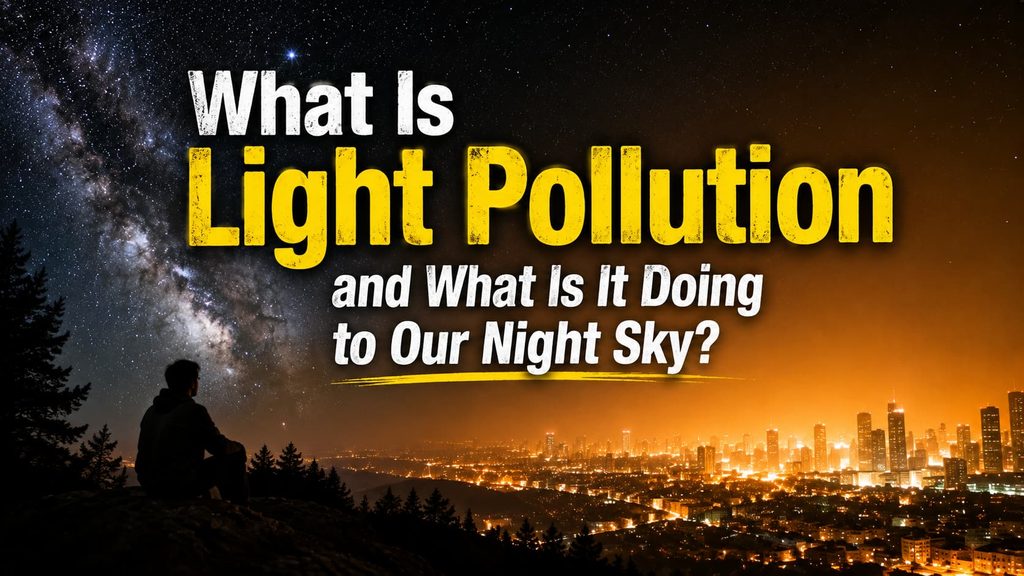
Look Up Tonight. How Many Stars Can You Actually See?
Step outside where you live, on any clear night. What do you see?
Streetlights. The glow of apartment windows. Office towers that never fully switch off. Billboards. Shop signs. The smeared amber light of a city that does not really have a night anymore.
Look up. Perhaps a handful of stars, the brightest ones, managing to push through. Perhaps the moon. & Perhaps nothing else at all.
Now imagine standing somewhere far from all of that. No towers, no traffic, no illuminated signs on the horizon. The surroundings go properly dark. You let your eyes adjust for a few minutes. And then you look up.
The sky is enormous. Stars appear not just in clusters but scattered across the entire visible dome above you, more than you can count, more than you expected. The Milky Way, a broad, soft band of light, becomes visible to the naked eye.
The stars have not suddenly appeared. They were always there. The light around you simply stopped hiding them.
What Exactly Is Light Pollution?
Not all artificial light is a problem. Lighting serves essential functions: safety, navigation, healthcare, and everyday life depend on it. Light pollution is specifically about light that is excessive, poorly directed, or used at the wrong time and place.
It takes several distinct forms.
🌆Skyglow: the persistent bright glow that sits over cities and populated areas, turning the night sky orange, white, or grey rather than dark. This is the primary reason stars are invisible from most urban locations.
💡Glare: excessively bright light that creates discomfort, reduces visibility rather than improving it, and can contribute to road safety concerns rather than resolving them.
🏠Light trespass: light falling where it is neither needed nor wanted, such as a bright streetlight shining directly through a bedroom window at night.
🏙️ Clutter: an excessive number of bright, competing light sources in a single area, creating visual confusion and collectively contributing to a brighter sky.
Why Can’t We See the Stars From Cities?
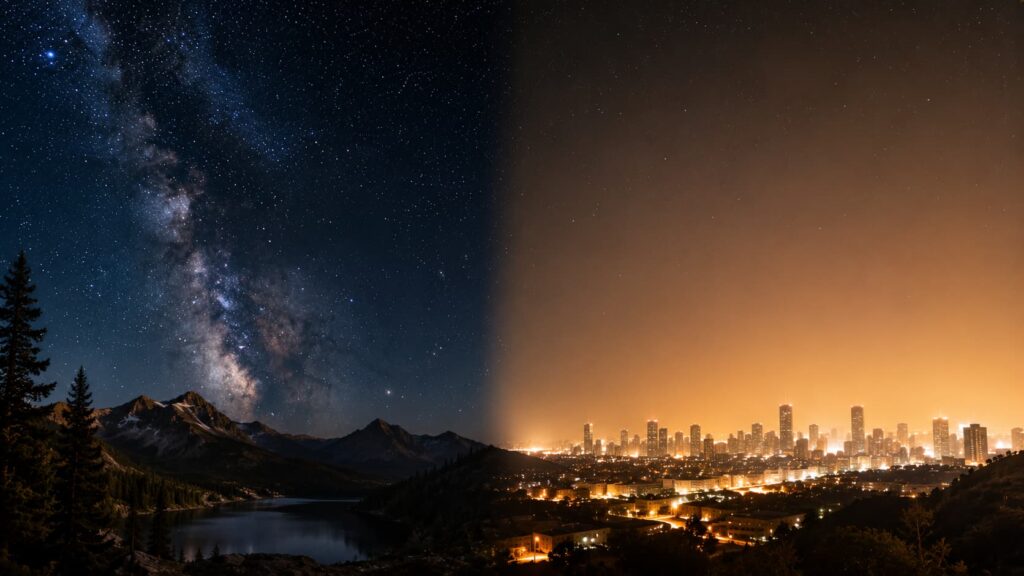
Artificial light does not stay on the ground. Much of it travels upward and outward, where it encounters particles and moisture in the atmosphere. These particles scatter the light, spreading it diffusely across the sky rather than allowing it to pass outward into space.
The result is skyglow: a brightened sky that makes it progressively harder for the human eye to detect fainter stars. The eye requires a period of dark adaptation to see dim objects, and a bright sky prevents that adaptation from occurring fully.
Astronomers use the Bortle scale, a nine-point scale developed by amateur astronomer John Bortle in 2001, to describe the darkness of a night sky at any given location. A Bortle 1 sky is the darkest possible, with the Milky Way casting visible shadows. A Bortle 9 sky, typical of an inner city, shows only the brightest stars and no Milky Way at all. Most people alive today rarely experience anything below a Bortle 6 or 7.
How Much of the Night Sky Are We Losing?
A study published in Science (Fabio Falchi et al., 2016) found that more than 80 percent of the world’s population and more than 99 percent of people in the United States and Europe live under light-polluted skies. Approximately one-third of humanity cannot see the Milky Way from where they live.
More recent research published in Science (Kyba et al., 2023), drawing on citizen-science observations from the Globe at Night project, found that the naked-eye limiting magnitude of the night sky declined significantly between 2011 and 2022, meaning the number of stars visible to the unaided eye decreased at a rate faster than satellite-based measurements had suggested. The night sky is becoming measurably brighter, and the stars accessible to ordinary human experience are quietly disappearing from view.
For many people alive today, seeing a genuinely dark sky is becoming an increasingly unusual experience. It is something encountered in photographs rather than in person.
The Stars Are Not the Only Ones Affected
Insects
Many insects are drawn to artificial light, a behavior observed and puzzled over for centuries. Several hypotheses attempt to explain it, including disruption of natural celestial navigation systems that insects evolved to use when light only came from the moon and stars.
The consequences include: insects spending energy circling light sources rather than feeding or mating, becoming easier prey in illuminated areas, and being unable to complete normal behavioral cycles. Given that insects underpin food webs across most ecosystems, disturbances to insect populations can have effects extending well beyond the insects themselves.
Birds
Many migratory bird species use celestial cues for navigation during long-distance seasonal journeys. Artificial lighting from illuminated buildings and urban areas can disorient them, particularly during night migration. Research has documented collision events with brightly lit structures, and some cities have introduced lights-out initiatives during peak migration periods to reduce these incidents.
Nocturnal Animals
Animals that evolved to function in darkness, from bats to foxes to owls to sea turtles, rely on darkness as a functional component of their environment. Artificial lighting can alter feeding patterns, reduce habitat use in illuminated areas, disrupt reproduction, and expose nocturnal animals to greater predation risk.
For wildlife, darkness is not simply the absence of light. It is part of the habitat.
What Does Light Pollution Do to Us?
Human biology is built around the light-dark cycle. The circadian rhythm, the internal biological clock that regulates sleep, wakefulness, hormone release, body temperature, and many other functions, takes its primary cues from light exposure.
Research on night-time light exposure and circadian disruption has grown considerably. Studies have found associations between exposure to artificial light at night, particularly to shorter-wavelength blue-rich light emitted by LED screens and modern lighting, and delayed sleep timing, reduced sleep duration, and suppressed melatonin production (Gooley et al., Journal of Clinical Endocrinology and Metabolism, 2011).
This does not mean that city streetlights alone explain every modern sleep problem. Sleep is affected by many factors, and individual responses to light exposure vary. But night-time light is one factor that has changed substantially in the lifetimes of most people currently alive, and its effects on biological timing are biologically plausible and increasingly well-documented.
Why Darkness Actually Matters
Modern life treats darkness as a problem to be solved. The instinct is to add more light: brighter streetlights, more external lighting on buildings, illuminated signage that never switches off.
But darkness serves purposes that artificial light cannot replace. It allows the human body to follow its natural biological timing. It gives nocturnal animals the habitat they evolved to function in. & It allows ecosystems to operate in the dark-phase cycles they developed over millions of years. And it allows human beings to see the sky above them as it actually is.
We spend so much of our lives trying to make the night brighter that we have forgotten that darkness is also part of nature.
What the Night Sky Meant to Earlier Generations
Before widespread electric lighting, which became common only in the twentieth century, every clear night offered an unobstructed view of thousands of stars. For most of human history, the night sky was not a special occasion. It was simply what darkness looked like.
People navigated by it. They tracked seasons through the positions of stars. Calendars were built from observations of the sky. In India, the night sky has been central to centuries of astronomical tradition, cultural festivals, and agricultural timing, much of it encoded in the astronomical treatises and practices of classical Indian civilization.
Stories were told about the stars. Mythologies developed to make sense of their patterns. The sky was a shared reference that connected people across generations and across cultures.
What happens to a generation that has rarely seen the sky their ancestors saw almost every night? That question does not have a simple answer. But it is worth asking.
What Can We Do About Light Pollution?
At Home
- Turn off outdoor lights when they are not needed
- Use motion sensors or timers rather than lights that run all night
- Choose properly shielded fixtures that direct light downward rather than upward and outward
- Avoid unnecessarily high-brightness lighting where lower brightness would serve equally well
- Keep bedrooms as dark as reasonably possible during sleep hours
In Communities
- Advocate for downward-facing street lighting that reduces upward light scatter
- Support warmer, less intrusive colour temperatures in public lighting where safety allows
- Encourage lighting-off policies for illuminated buildings during night-migration periods
Good lighting is not about having more light. It is about having the right light, in the right place, at the right time.
Can We Still Experience a Darker Sky?
Moving away from dense urban light sources can make a substantial difference. You do not necessarily need to reach an internationally designated dark-sky reserve to see significantly more stars than a city allows. Sufficient distance from major population centres, combined with clear weather and a new moon phase, can reveal a sky that most urban residents have never seen from where they live.
Rural India, particularly in areas away from major highways and towns, still offers skies that urban populations rarely experience. The difference between a city sky and a rural sky, when the conditions are right, is not subtle. It is the difference between a handful of visible stars and thousands.
The Night Sky at Off Grid Rajasthan
When the Sky Becomes the Main Attraction
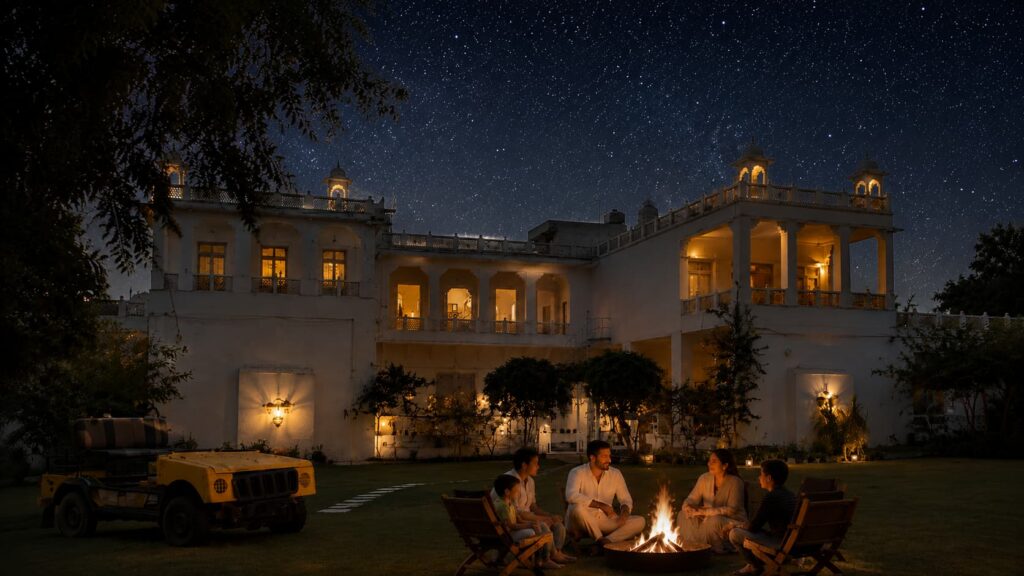
Off Grid Rajasthan is located in Kotputli, Rajasthan, in the open countryside away from major urban light sources. At night, the surrounding area offers something increasingly rare for people accustomed to city environments: the natural darkness of the countryside.
The day’s heat fades. The surroundings quiet. There are fewer competing artificial lights on the horizon. Step outside and allow your eyes several minutes to adjust. The sky that appears is a darker sky than most city residents see more than once or twice in their lives, one that reveals far more stars than the city allows.
Not a guarantee of any specific celestial event: the number of visible stars depends on weather, moon phase, and local conditions. But in suitable conditions, a rural sky in this region can offer a meaningfully different experience of the night than any city environment provides.
You might sit outside for a while. You might talk, or not. & You might simply look upward for long enough that the sky stops being background and becomes something you are actually seeing.
Some nights are worth photographing. Some are worth simply remembering.
- Open countryside with reduced light competition from urban sources
- Clear Rajasthani nights in suitable seasons offering favorable stargazing conditions
- Space and quiet to allow proper dark adaptation, which takes fifteen to thirty minutes
- A genuinely different quality of darkness from the city’s perpetual glow
Plan your stay at Off Grid Rajasthan
A Simple Challenge: Spend One Night Looking Up
Tonight, or the next clear night, try this. Switch off unnecessary lights. Step outside. Do not reach for the phone. Allow your eyes fifteen minutes to adjust to the darkness properly.
- Look at the sky and count the stars you can see
- Try to identify one constellation without using an app
- Notice what you can see toward the horizon and what the horizon color actually is
- Stay for fifteen minutes without checking anything
Then compare what you saw with a memory of a darker sky, a village visit, a hillside, a beach at night far from a town. The difference between what your eyes receive in each setting tells you something precise about what has been lost.
The stars haven’t gone anywhere. We just need to give ourselves a darker place to see them.
Frequently Asked Questions
Q1. What is light pollution?
Ans. Light pollution is excessive, misdirected, or unnecessarily bright artificial light at night. It includes skyglow (the bright glow over cities), glare, light trespass (light entering spaces where it is not wanted), and clutter from too many competing light sources. Research shows artificial night-time brightness has increased substantially in recent decades, reducing access to naturally dark skies for the majority of the world’s population.
Q2. Why can’t we see stars from cities?
Ans. Artificial light from cities travels upward and is scattered by atmospheric particles, creating skyglow that brightens the night sky. The human eye requires darkness to adapt and detect faint stars. A brightened sky prevents this dark adaptation. Studies including Falchi et al. (Science, 2016) found that more than one-third of humanity cannot see the Milky Way from where they live due to light pollution.
Q3. Does light pollution affect wildlife?
Ans. Yes. Many species evolved around predictable cycles of light and darkness. Artificial lighting can disorient migrating birds, disrupt insect navigation and behavior, alter bat feeding patterns, and reduce the functional habitat of nocturnal animals. Because insects underpin food webs, disruptions to their behavior can have wider ecological effects. Research in this area has grown considerably over the past two decades.
Q4. Does artificial light at night affect human sleep?
Ans. Research suggests that exposure to artificial light at night, particularly blue-rich light from LEDs and screens, can suppress melatonin production and delay sleep timing. A study in the Journal of Clinical Endocrinology and Metabolism (Gooley et al., 2011) found significant melatonin suppression with evening light exposure. Individual responses vary, and sleep is affected by many factors, but night-time light exposure is biologically relevant to circadian function.
Q5. What is the Bortle scale?
Ans. The Bortle scale is a nine-point scale developed by amateur astronomer John Bortle in 2001 to describe the darkness of the night sky at a given location. Bortle 1 represents the darkest possible sky, where the Milky Way casts faint shadows. Bortle 9 represents a heavily light-polluted inner city sky where only a few bright stars are visible. Most urban and suburban residents rarely experience skies below Bortle 6.
Q6. What can I do about light pollution at home?
Ans. Practical steps include switching off unnecessary outdoor lights, using motion sensors or timers, choosing downward-shielded light fixtures that direct light toward the ground rather than upward, selecting warmer color temperatures rather than blue-rich white LEDs, and keeping bedrooms dark during sleep. These measures reduce skyglow contribution and can improve sleep quality by limiting night-time light exposure.
Q7. Can you see the Milky Way from rural Rajasthan?
Ans. In suitable conditions, including clear weather, a new moon phase, and sufficient distance from urban light sources, a rural sky in areas like Kutli, Rajasthan can reveal far more stars than city environments allow. Whether the Milky Way is visible depends on specific local conditions, season, and weather. Rural areas in India generally offer significantly darker skies than major cities, and the difference in star visibility can be substantial.
Q8. What is dark adaptation and how long does it take?
Ans. Dark adaptation is the process by which the human eye adjusts to low-light conditions, allowing it to detect fainter objects. It primarily involves the rod photoreceptors, which are more sensitive to low light than cones. Full dark adaptation takes approximately 20 to 30 minutes. During this period, avoiding bright light sources, including phone screens, is important. Many people who step briefly outside at night never allow their eyes to adapt fully.
Off Grid Rajasthan
Farmstay · Organic Living · Nature Retreat · Kotputli, Rajasthan