
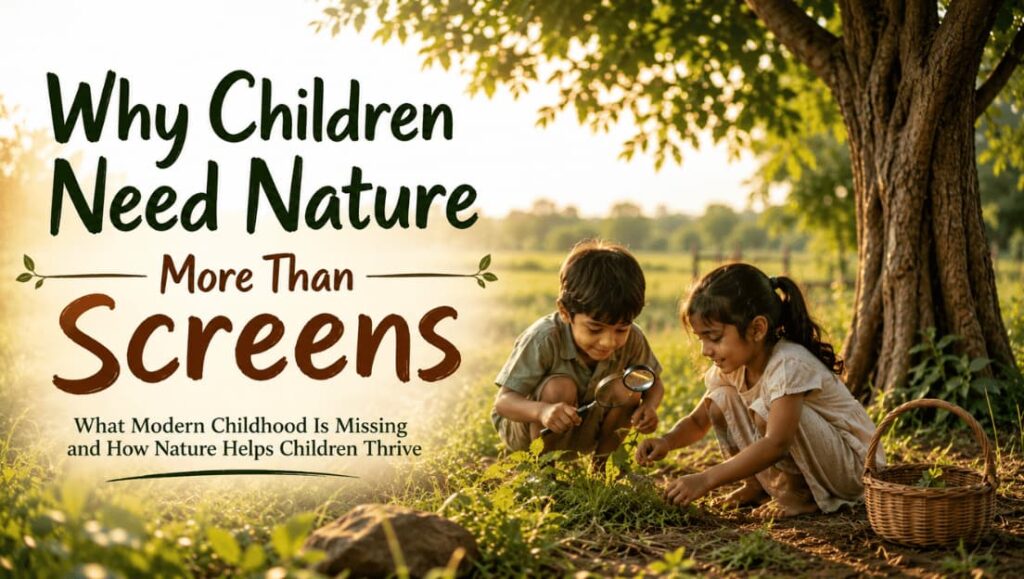
What Modern Childhood Is Missing and How Nature Helps Children Thrive
Close your eyes for a moment and go back.
A summer afternoon, decades ago. The sun is high and hot and nobody cares. There is a group of children somewhere between a mango tree and a muddy pond, inventing a game with no name and no rules. Someone falls. Someone laughs. & Someone finds a beetle and announces it like a discovery that changes everything. Nobody is thinking about what comes next. Nobody needs to. The world has shrunk to the size of one perfect afternoon, and that is more than enough.
Now open your eyes.
A child sits on a sofa, still, eyes fixed on a glowing rectangle. The room is cool and quiet. Everything they could ever want to watch, play, or listen to is available instantly and endlessly. And somehow, within twenty minutes, they are bored. Within an hour, they are irritable. By evening, asking for more screen time with an urgency that feels almost desperate.
Something is off. Most parents feel it. The question is what to do about it.
The answer is not complicated. It is just increasingly rare. Children need nature. Not as a reward, not as a structured activity, not as an educational experience with a learning outcome attached. They need it the way they need food and sleep: as a fundamental condition for growing well.
Childhood Has Changed More Than We Realize
The shift happened gradually, which is part of why it is so easy to miss. No single moment when childhood moved indoors. Just a slow accumulation of small changes: a phone here, a tablet there, a summer vacation that stayed inside because the weather was too hot, a weekend that stayed inside because it was just easier.
A generation ago, children came home from school and disappeared outside until dinner. The neighbourhood was the playground. The rules were made up. The injuries were minor and the memories were enormous. Play was physical, imaginative, and entirely self-directed. It ended only when someone was called inside.
Today, the average child in an urban Indian home spends more hours looking at a screen each day than they spend in any form of physical outdoor activity across an entire week. This is not a criticism of parents, who are navigating a world that has genuinely changed. It is simply a fact, and one worth sitting with.
| Then | Now |
| Trees to climb | Touchscreens to swipe |
| Mud and open fields | Mobile games and indoor apps |
| Outdoor games till sunset | Indoor entertainment from morning |
| Exploration and discovery | Scrolling and watching |
| Imagination-led play | Algorithm-led content |
| Community and neighbourhood friends | Online interactions with strangers |
Neither column is entirely good or entirely bad. But the balance has shifted so far in one direction that many children are growing up without experiences that were, for all of human history before this moment, simply what childhood was.
What Too Much Screen Time Does to Children
This is not an anti-technology argument. Screens have genuine value. They offer learning, creativity, connection, and entertainment. The concern is not the screen itself. It is the ratio: when screens fill the space that movement, nature, and unstructured play once occupied, something gets lost in the displacement.
Physical Effects
Children who spend extended hours on screens typically move less. Less movement means weaker muscles, poorer coordination, and less developed balance. Eye strain is common: screens demand a fixed focal length for hours, which the eyes are not designed to sustain. Posture suffers. Sleep suffers most of all: the blue light from screens suppresses melatonin production, making it genuinely harder for a child’s body to fall into the deep sleep it needs to grow and recover.
Mental Effects
Screens are designed, by brilliant people with considerable resources, to be as engaging as possible. The result is content that delivers stimulation in very short bursts, constantly refreshed, constantly new. The child’s brain adapts to this pace. Anything slower, a book, a conversation, a walk, a task that requires sustained focus, begins to feel unbearable. Attention spans shorten not because children are less capable, but because their brains have been trained by a particular kind of experience.
Emotional Effects
Perhaps the subtlest effect, and in some ways the most important, is emotional. Children who spend significant portions of their waking hours on screens often become dependent on that level of stimulation for their sense of okay-ness. When the screen goes away, nothing in the ordinary world feels interesting enough. Frustration arrives quickly. Patience thins. The capacity to simply be, without being entertained, quietly erodes.
Signs Your Child May Need More Time Outdoors
- Gets bored quickly in the absence of a screen
- Becomes irritable or upset when screen time ends
- Has difficulty falling asleep or sleeping deeply
- Shows little interest in physical play or movement
- Struggles to focus on a single activity for more than a few minutes
- Seems restless, overstimulated, or emotionally flat
- Rarely initiates imaginative or creative play independently
What Happens When Children Spend Time in Nature
The research on this is not ambiguous. Across dozens of studies, in multiple countries, looking at children of different ages and backgrounds, the conclusion is consistent: time in natural environments makes children healthier, calmer, more creative, and more emotionally resilient. Not as a side effect. As a direct result.
Nature Encourages Curiosity
A screen provides content. Nature provides questions. What is that sound? Why is this rock a different colour? Where does this path go? How did this nest get here? These are not questions with quick answers. They are invitations to look more closely, to think, to wonder, to return tomorrow and check if anything has changed.
A child exploring a patch of ground near a tree is not doing nothing. They are developing the foundational capacity for inquiry: the ability to notice, to be curious, to pursue a question for its own sake. This is the same capacity that drives every significant human achievement, and it is built most naturally in the first years of life, in conditions that make curiosity possible.
Nature Builds Physical Competence
- Running on uneven ground develops ankle strength and proprioception that a flat floor never challenges.
- Climbing a tree builds grip strength, spatial awareness, and the ability to assess risk in ways that no playground equipment quite replicates.
- Swimming in a natural body of water, navigating a muddy path, carrying something heavy across a field: these are physical experiences that develop the body in ways that structured exercise simply cannot.
Children who spend regular time in natural environments tend to be more physically coordinated, more physically confident, and more capable of managing the ordinary physical demands of a life lived in a body. They fall less. They recover faster. & They are less afraid of minor physical challenge.
Nature Helps Children Feel Calmer
There is something measurable that happens to the nervous system in natural environments. Cortisol, the primary stress hormone, drops. Heart rate slows. Breathing deepens. The body moves into a state that researchers call restorative, meaning it is actively recovering from the demands that ordinary life places on it.
For children who carry anxiety, who struggle with emotional regulation, or who simply live in the high-stimulation environment that modern childhood typically involves, time in nature is not merely pleasant. It is therapeutic. It gives the nervous system what it cannot find indoors: genuine quiet, sensory input that does not demand a response, and a pace that the body can actually rest inside.
Nature Unlocks Imagination
Put a child in a room full of the most sophisticated toys available and watch what happens after an hour. Then put the same child outside near some trees, a few rocks, and a stretch of open ground. The difference in what they create is extraordinary.
Outside, a stick becomes a sword, a staff, a fishing rod, a magic wand. A stone becomes treasure, a building material, a marker for a boundary in a game only the child fully understands. A fallen tree is a bridge, a castle wall, a ship in a storm. Nature provides raw material and no instructions, which is exactly what imagination needs to grow. It is the opposite of a screen, which provides all the content and requires none.
The child who has spent an afternoon in a forest comes home with stories. The child who has spent an afternoon on a tablet comes home wanting more tablet.
Lessons Nature Teaches That Screens Cannot
Beyond health and development, time in nature teaches children a particular kind of wisdom that no amount of content consumption can provide. These are lessons learned not through watching or reading, but through being.
Patience
A seed planted today does not sprout tomorrow. A bird at the feeder does not arrive on demand. Clouds move on their own schedule. In a world of instant delivery and immediate content, nature is one of the last places where children learn that some things cannot be hurried. This is not a small lesson. It is the foundation of almost every meaningful skill a human being will ever develop.
Responsibility
A plant that is not watered dies. An animal that is not fed suffers. These are not dramatic lessons, but they are real ones. Caring for something living teaches a child that their actions have consequences that extend beyond themselves, and that some things in the world depend on them. This is the beginning of empathy, and it is learned in the hands, not on a screen.
Observation
Watching a colony of ants work, noticing the way a spider builds, tracking the movement of birds through a morning, seeing how the light changes across a field from hour to hour: these are exercises in sustained attention of the deepest kind. The child who learns to truly observe the natural world is developing a capacity that will serve them in every domain of life, from science to art to human relationship.
Gratitude
When a child understands that food comes from soil, that clean water is not guaranteed, that the shade of a tree is a gift given slowly over years, the relationship with ordinary things shifts. Children who have grown vegetables tend to eat them more willingly. Children who have seen what it takes for a mango to reach their plate experience it differently. Gratitude is not taught through lectures about gratitude. It is grown in proximity to the real world.
Simple Ways to Bring Nature Back Into Your Child’s Life
None of this requires a dramatic lifestyle change. The most powerful shifts often begin with very small adjustments, held consistently over time.
- Morning walks before school, even fifteen minutes, without screens and without agenda
- A small patch of garden, a pot on a balcony, something the child is responsible for watering and watching
- Nature scavenger hunts: a list of things to find, a stretch of park or green space, no timer
- Bird watching from a window or a balcony, a simple activity that builds the habit of noticing
- Family picnics that are genuinely unplugged: no phones, just food and outdoor time together
- Barefoot walks on grass, mud, or natural ground, even briefly, on a regular basis
- Farm visits that connect children to where food actually comes from
- Evenings outdoors instead of indoors, even once a week, watching the sky change
The goal is not perfection. It is direction. A child who spends an hour outside every day is building something that will last far longer than any content they consume in that same hour.
Why Experiences Matter More Than Toys
Think back to the gifts you received as a child. Now think back to the experiences. Which ones do you still carry?
Children have an extraordinary capacity for forgetting objects and remembering experiences. The toy from a birthday three years ago is gone from memory. The afternoon spent feeding goats on a farm, the morning a butterfly landed on a hand held completely still, the evening a child first saw the Milky Way from somewhere dark enough to show it clearly: these do not fade. They compound. They become part of how a child understands what the world is and what it is capable of offering.
This is not a romantic idea. It is how human memory works. Emotional, sensory, and novel experiences are encoded differently from routine ones. The brain holds them differently. They become reference points that a child returns to, consciously and unconsciously, for years.
A gadget updates. A game gets boring. A new toy is surpassed by a newer one within a season. But the memory of waking before sunrise and watching the sky change color over an open field, of running barefoot across damp morning grass, of hearing the first birds before the rest of the world woke up, that memory does not have a newer version. It simply stays, whole and vivid, for a lifetime.
The greatest gift a parent can give a child is not the most advanced device of the moment. It is the experience of a world that exists beyond any device.
Creating the Childhood Memories That Last a Lifetime
Everything described in this article is available. Not in the past, not in memory, not in someone else’s childhood. Available now, in places where the pace is slower, the sky is wider, and the ground is real beneath a child’s feet.
At Off Grid Rajasthan, in the open countryside of Village Mangalwa, Bansur, children step into an environment that most of them have never experienced and immediately recognize as something they needed. There are no schedules designed around entertainment. There is no curated agenda. & There is a working farm, open fields, organic food growing in soil they can touch, birds they can watch, and a sky at night that shows them the universe in a way that no screen ever will.
Children who visit leave talking about what they did and what they felt, not what they watched. They leave with mud on their shoes and something quieter and more settled in their eyes. They leave with a memory.
- Explore open fields and natural surroundings freely
- Watch and learn about birds, insects, and farm animals
- Walk barefoot on real earth and feel the ground change underfoot
- See where food comes from: hydroponic gardens, organic cultivation, farm-fresh meals
- Experience genuine darkness and a sky full of stars
- Breathe air that is clean and a pace that is genuinely slow
- Simply be outside, without a screen, without a schedule, for as long as it takes
Sometimes the greatest gift we can give a child is not another gadget.
It is a memory. A real one. Made outside, under an open sky, in a world that does not need a password.
Plan your family’s stay at Off Grid Rajasthan
The children who grow up with at least some of their time rooted in the natural world carry something into adulthood that is very difficult to acquire later. A comfort in their own company. An ability to be still. A sense of proportion that comes from having stood under big skies and felt appropriately small. A knowledge, held in the body rather than the mind, that the world is larger and more generous than any screen has ever managed to show.
That is not a small inheritance. It may be the most important one a childhood can offer.
Give them roots in the earth before you give them wings on the internet.
Off Grid Rajasthan
Farmstay · Organic Living · Nature Retreat · Rajasthan