

Is ‘good energy’ in a garden just a feeling, or is something actually happening inside your brain and body?
What Do We Mean When We Say This Place Has Good Energy?
You walk into a garden and something shifts. It is hard to name precisely what. You breathe more slowly, and you notice that you are breathing more slowly, which is itself unusual. You stop checking your phone. You find yourself wanting to sit somewhere, under a tree or beside something growing, without any clear reason. The place simply feels different from the street you came in from.
People often describe this as energy. Good energy. Peaceful energy. The energy of a place.
Is that real? Or is it simply a pleasant feeling that we have dressed up in spiritual language?
The honest answer is both, and the distinction matters less than it might seem. We often use the word energy to describe an experience that is genuinely happening, even when the experience is more accurately described through the language of senses, nervous system, attention, and environment. Science explains parts of what we feel in a garden. It does not require us to abandon the feeling in order to understand it.
Your Brain Notices a Garden Before You Realise It
Before a conscious thought has formed about where you are, the brain is already processing the environment. Colour, pattern, movement, sound, smell, temperature, texture: these arrive through the senses simultaneously and continuously, and the brain is constantly making sense of them.
A natural environment sends a particular kind of information.
- Organic shapes rather than right angles.
- Sounds that vary rather than repeat.
- Movement that is irregular and gentle rather than sharp and demanding.
- Light that changes rather than remaining constant.
- Smells from soil, leaves, flowers, and damp earth that are distinct from concrete, exhaust, and air conditioning.
Unlike a city street or a screen-filled room, a garden generally does not demand constant conscious responses. Nothing is asking for your attention urgently. Nothing needs to be processed as a potential threat or an immediate obligation. The environment simply is.
A garden doesn’t give you energy in the way a battery charges a device. It creates conditions in which the mind behaves differently. That difference is what we experience as feeling better.
Why Nature Can Make the Mind Feel Quieter
Modern life requires what environmental psychologists Rachel Kaplan and Stephen Kaplan termed directed attention: the sustained, effortful focus needed to navigate work, screens, traffic, notifications, and the constant demands of a connected daily life. Directed attention is a limited resource, and using it continuously depletes it.
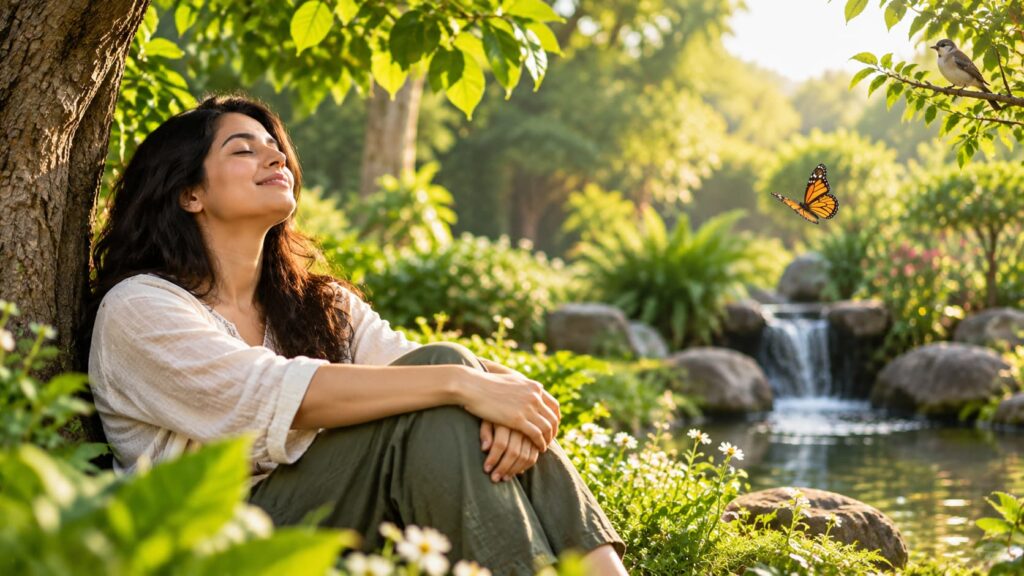
Natural environments contain what the Kaplans described as soft fascination: a quality of gentle, effortless interest that holds attention without demanding it. Watching leaves move in wind. Following a butterfly’s path without purpose. Listening to birds without trying to identify them. Watching water, clouds, or changing light.
These experiences engage the attention lightly. The directed attention system, the one running at full capacity all day, gets to rest. This is the basis of Attention Restoration Theory, supported by research published in the Journal of Environmental Psychology and other peer-reviewed journals, and it helps explain why spending time in nature can leave people feeling mentally refreshed in ways that equivalent periods of indoor rest do not always provide.
The Five Senses Are Doing More Than You Think
What a garden offers is a complete sensory environment, and each sense contributes something to the overall experience.
👁️Sight: Natural greens, the particular patterns of leaves, the irregular shapes of growing things, changing light across a morning or afternoon: these engage the visual system in a qualitatively different way from the rectangular uniformity of screens and urban architecture.
👂Sound: Birdsong, the movement of leaves, insects, wind: a natural soundscape layers sounds that arrive irregularly and carry no social obligation. Unlike a phone notification or a traffic horn, no bird requires a response.
👃Smell: Soil, growing plants, flowers, herbs, damp earth after rain: the olfactory environment of a garden is rich and varied. Because the olfactory system has a direct anatomical connection to the brain’s memory and emotional centers, smell can produce rapid and unexpected shifts in mood and memory.
🤲 Touch: Walking barefoot on soil or grass, touching bark or leaves, handling soil or water: physical contact with natural materials provides sensory input that most urban environments do not. Research on grounding or earthing suggests that direct skin contact with the earth may influence certain physiological markers, though this area of research is still developing.
👅 Taste: A tomato eaten directly from the plant, a herb pinched and tasted, fresh vegetables harvested and eaten close to where they grew: these are qualitatively different experiences from food eaten from packaging.
None of these automatically produce healing or transformation. But sensory experiences shape mood, attention, and perception in measurable ways, and a rich, natural sensory environment is genuinely different from the sensory environment of most working days.
Why Gardening Feels Different From Simply Looking at Nature

There is a meaningful difference between seeing a garden and being in one. Observation is one kind of experience. Participation is another.
Gardening involves touching soil, planting something and watching what happens over days, watering at a particular time because the plant needs it at that time, noticing the arrival of insects and birds that the growing things attract, waiting for fruit or vegetables to be ready, and finally harvesting and tasting what grew from something you planted. The timeline is long. The rewards are real. The involvement is physical, patient, and ongoing.
This is a qualitatively different relationship with living things than looking at them through a window. You are not observing nature. You are interacting with it, and it is responding to you, slowly and on its own terms.
Gardening may be one of the few activities that requires us to be patient with a living thing in ways that cannot be negotiated. The plant grows when it grows. Your schedule is irrelevant to it.
Can Plants Really Change the Energy of a Space?
Many people, including those who would not describe themselves as spiritual, feel that certain spaces, particularly those with plants, gardens, and natural materials, simply feel better to be in. The language they reach for is often the language of energy.
Science does not establish that plants emit a mystical energy field that alters human consciousness. What science does establish is that plants change the physical environment around them in ways that are directly relevant to human experience: they alter humidity, produce oxygen, absorb some airborne compounds, create shade, reduce ambient temperature in their immediate surroundings, contribute to natural soundscaping by absorbing and dispersing sound, and provide visual and olfactory stimulation.
The experience of feeling better in a garden is not an illusion. It is a real experience, produced by real changes in a real environment. Whether that is best described as energy, atmosphere, or sensory conditions is a matter of language, not a disagreement about whether the experience itself is genuine.
What Happens When You Spend More Time Around Living Things?
A garden is also, quietly, a teacher of things that modern life rarely demonstrates.
Growth takes time and cannot be rushed. A seed becomes a plant on a timeline that has nothing to do with your productivity targets. Seasons change whether or not they are convenient. Some things need consistent care over a long period before they produce anything visible. Neglect has consequences. Attention is rewarded slowly, not immediately.
These are not lessons that arrive as thoughts. They arrive as experience: the physical, repeated experience of tending something living, watching it respond, waiting for it, and eventually receiving what it offers.
Nature does not operate on our deadlines. Being in proximity to growing things regularly is a reminder of that, and the reminder tends to produce something in people that resembles perspective.
Why an Organic Farm Feels Different From a Decorative Garden
A decorative garden is primarily something to look at. The experience is predominantly visual, pleasant, and passive.
An organic farm is something to learn from, participate in, and receive from.
- The soil being actively cultivated.
- Compost returning organic matter to the ground.
- Seeds going in, germinating, becoming seedlings, becoming crops.
- Insects and pollinators arriving because there is something there for them.
- Vegetables grown without synthetic chemicals, tasted close to where they grew.
The experience of an organic farm engages not just the eye but the hands, the nose, the sense of time, and the understanding of where food actually comes from. For many people who have spent their entire lives receiving food in packaging, this understanding arrives as something genuinely surprising.
Try This: The 15-Minute Garden Energy Experiment
Before deciding whether nature changes your energy, try this. Find any garden, courtyard, or green space. Leave your phone in your pocket and sit down.
Minutes 1 to 3: Sit quietly. Do not reach for your phone. Let your attention settle wherever it wants to go.
Minutes 4 to 6: Notice five things you can see. Not just a general impression: specific things, a particular leaf, the way light hits the ground, one bird, one cloud.
Minutes 7 to 9: Listen for five distinct sounds. Not as a task, just paying attention to what is actually audible rather than what the usual day contains.
Minutes 10 to 12: Notice smells, air temperature on skin, and the quality of the air around you. Is it moving? Still? Warmer or cooler than inside?
Minutes 13 to 15: Choose one plant or one small section of the garden. Observe it closely. The detail of a single leaf. How many shades of green are actually there.
At the end of fifteen minutes, ask honestly: do you feel different from when you arrived? Not different in a mystical way. Different in the way that your attention is placed, your breathing has settled, the mental noise has reduced slightly.
That difference is not a claim about energy. It is a description of what happens when a human nervous system is given fifteen uninterrupted minutes in a natural environment.
Experience Nature, Don’t Just Read About It
Off Grid Rajasthan is located near Kotputli, Rajasthan, in the open countryside away from the rhythm of urban life. It is not a resort or a curated wellness program. It is a working farm, organically cultivated, with hydroponic growing spaces, and open natural surroundings.
What a visitor actually experiences here is not designed. It arrives through proximity to real things: soil, growing plants, open sky, birdsong, organic food prepared from produce grown a few steps from where it is eaten.
- Waking up surrounded by open landscape rather than apartment walls and city noise
- Spending time in and around the garden and farm spaces, touching soil, observing growth, understanding where food comes from
- Seeing both organic cultivation and hydroponic farming as living processes rather than abstract concepts
- Sitting outdoors without the constant pull of digital stimulation, because the environment itself provides something worth paying attention to
- Watching the sky change across a full day in a place where the horizon is visible
- Eating food that grew nearby, tasting the difference that proximity and organic cultivation make
Offgrid Rajasthan is a destination for people looking to step away from highly structured urban routines and experience a closer, more direct relationship with the natural world. Nature is not the backdrop here. It is the experience itself.
Can a Garden Change Your Energy? Come Find Out for Yourself.
You do not have to decide whether nature changes your energy before you arrive. Come and sit in a garden. Touch the soil. Walk through the growing spaces. Watch the light change. Listen to what is audible when the notifications stop. Eat something that was growing this morning.
Notice how you feel before. Notice how you feel after. The comparison will tell you more than any article can.
At Off Grid Rajasthan, nature isn’t just the backdrop. It is the experience.