
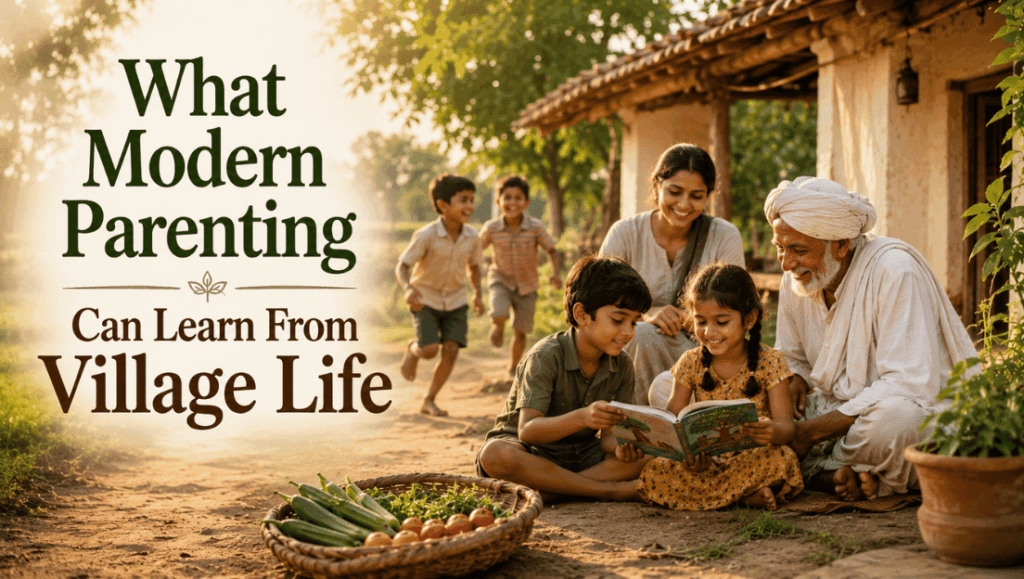
Timeless Lessons That Help Children Grow Strong, Kind, and Connected
There has never been a generation of parents who worked harder at parenting.
Children today are enrolled in better schools, taken to better doctors, given more opportunities than any previous generation could have imagined. Parents research nutrition and sleep schedules. They read about brain development. They choose toys carefully, monitor screen time anxiously, shuttle children between activities with genuine love and considerable effort. By almost every measurable input, modern parents are doing more.
And yet the worry does not go away. It sits quietly at the edge of every careful decision.
- The child who has everything seems anxious.
- The child who is constantly entertained cannot manage boredom.
- The child who has never been neglected struggles, somehow, to be resilient.
- Screen time climbs despite best intentions. Focus thins.
- Social skills feel fragile in a way that is hard to put a finger on.
Most parents feel this gap without knowing quite how to name it. Something is being given, generously and with love. And something else, something harder to identify but just as essential, seems to be missing.
Could some of what is missing be found not in a new approach or a better routine, but in something much older? In the way children grew up in villages, in communities, in a relationship with the natural world and with each other that modern life has gradually replaced without fully understanding what it was replacing?
This article does not suggest that village life was perfect or that the answer is to go backward. It suggests something more specific: that village life, with all its limitations, passed on certain things to children that mattered deeply, and that those things are still available to any parent willing to look for them.
Children Once Grew Up With More Freedom
In a village, a child’s morning was largely their own. After whatever small responsibilities had been completed, the day opened up into unsupervised, unstructured time that could stretch for hours. Children roamed. They climbed. They fell out of trees and got up and tried again. & They invented games with arbitrary rules and argued about the rules and resolved the arguments without adult intervention because there was no adult to intervene.
This freedom was not carelessness on the part of parents. It was an understanding, held collectively and implicitly, that children needed space to encounter the world on their own terms. Small risks were part of the design, not a failure of protection. A child who scraped a knee on gravel was learning something about consequence and recovery that no supervised activity could teach in quite the same way.
The child who was always supervised, always scheduled, always cushioned from minor difficulty, was seen as a child being denied something. That instinct was right.
Modern parenting has, with the best of intentions, moved toward more structure, more supervision, and more management of children’s time. The result is children who are less practiced at navigating uncertainty, less confident in their own judgment, and less capable of generating their own sense of purpose in an unscheduled hour. They have not been failed. They have been over-helped.
Lesson for Today: Children need time that belongs entirely to them, unscheduled and unsupervised, to develop the confidence that comes only from managing small pieces of the world on their own.
The Village That Raised the Child
There is a reason the phrase ‘it takes a village to raise a child’ has survived so long. It is not a sentiment. It is a description of how child-rearing actually worked for most of human history, and of something that has been quietly lost in the shift to nuclear family urban life.
In a village, a child was known by everyone. The neighbour noticed if something seemed wrong. The older woman at the end of the lane had known the child’s parents and grandparents and had a kind of authority that came with that history. Grandparents were not occasional visitors but daily presences, passing on stories and values through proximity rather than lectures. Every adult in a child’s world was in some sense responsible for that child, and every child knew it.
This meant that children grew up surrounded by a variety of adult perspectives, temperaments, and life experiences. They were not shaped exclusively by their parents’ worldview. They absorbed wisdom from elders, humor from uncles, patience from grandparents, and the particular lessons that come only from watching people older than yourself navigate the world with the ease that experience brings.
Modern children, growing up in apartments in cities where neighbors are strangers, can go entire childhoods shaped almost entirely by their parents, their school, and their screen. The richness of that broader human ecosystem, the mentors and storytellers and watchful neighbors, is not there. And its absence leaves a particular kind of thinness in a child’s sense of the world.
Lesson for Today: Children thrive when they have trusted adults beyond their parents: grandparents, relatives, family friends, mentors who offer a wider view of the world and a different kind of belonging.
Children Learned Responsibility Early
Village children worked. Not in ways that were burdensome or inappropriate, but in ways that were real. They watered plants that needed watering. They fed animals that depended on them. They ran errands that actually mattered to the household’s functioning. & They cared for younger siblings with genuine responsibility, not as a game but as a task with real consequences if done badly.
This early experience of genuine responsibility did something important. It told children, through direct experience rather than words, that they were capable. That their actions mattered. That the world actually needed something from them, and that they could provide it. The confidence that grew from this was not the performance-based confidence of gold stars and praise. It was quieter and more durable: a settled sense of competence built on real evidence.
Chores in the modern household have become contested terrain. Many parents, exhausted and time-pressed, find it easier to do things themselves. Others worry about adding burden to already busy children. The result is children who reach adolescence and young adulthood with very limited practice at being genuinely useful, and a correspondingly limited sense of their own capability.
A child who has kept a plant alive for a season, who has been trusted to care for an animal, who has contributed something real and necessary to the running of a household, carries that experience forward. It becomes part of how they understand themselves: as someone the world can count on.
Lesson for Today: Give children responsibilities that are real and age-appropriate, not just tasks that keep them busy. Being genuinely needed builds confidence that praise alone cannot create.
Nature Was Their Playground, Their Classroom, and Their Therapist
The village child’s relationship with the natural world was not a scheduled activity. It was simply the texture of daily life. Fields were the backdrop to play. Trees were furniture. Animals were neighbours. The changing of seasons was something that happened to the body, not something observed through a window.
This constant, unremarkable contact with the living world produced effects that researchers are now spending considerable effort to document and name. Children who spend time in nature are physically healthier: stronger, more coordinated, more capable of the physical demands of an active life. They are mentally calmer: cortisol levels drop in green environments, attention restores, the nervous system settles into a state that modern indoor life rarely permits.
They are also more creative. Nature provides raw material without instructions. A stick, a stone, a patch of mud, a fallen tree: none of these come with a suggested use. The child must invent the use, which is exactly the cognitive work that builds imagination. And they are more emotionally resilient: a child who has experienced the indifference of the natural world, who has been rained on, who has waited patiently for something slow to happen, who has been in situations where the response of the environment did not depend on how they were feeling, develops a tolerance for difficulty that the managed indoor world rarely produces.
Not every moment of a child’s day needs to be productive, educational, or entertaining. Some moments need only to be outside.
Lesson for Today: Let nature be genuinely unstructured. A walk in a park with no destination, time in a garden with no task, an afternoon in open space with no plan. The benefit comes from the absence of structure, not from a nature-themed activity.
Children Were Less Entertained and Far More Creative
There was boredom in village childhoods. Long afternoons in summer when there was nothing to do and no device to fill the gap. And from that boredom, reliably and without fail, something emerged.
A stick became a sword. A tree became a fort that needed defending from an enemy that was very real in the imagination of the five children who had agreed it existed. A field became the territory of an entire civilization with its own history, its own rules, and its own ongoing conflicts. Stories were invented that lasted for days, picked up each afternoon exactly where they had been left, more elaborate with each telling.
This is what boredom does when it is not immediately rescued by entertainment: it creates. The child who learns to move through boredom into imagination is developing one of the most valuable cognitive capacities a human being can possess. They are learning to generate their own inner life, to be interesting company for themselves, to produce rather than simply consume.
The modern child who has never experienced boredom for longer than the few seconds it takes to reach for a screen has been protected from something that was actually good for them. The discomfort was the point. The gap was where the creativity lived.
Lesson for Today: Allow boredom. Resist the urge to immediately fill every unoccupied moment with entertainment. The restlessness that follows will, given enough time, turn into something worth watching.
Relationships Mattered More Than Possessions
Village children had fewer things. This is simply true. Fewer toys, fewer clothes, fewer gadgets, fewer options for entertainment. What they had in abundance was people: present, available, unhurried people who sat with them in the evenings and told stories and played games that required no equipment and left memories that lasted decades.
Ask any adult raised in a village or a simpler era about their childhood and they will describe people and moments, almost never possessions. The grandmother who told the same stories every night and somehow made them new each time. The evenings in the courtyard when the whole extended family gathered and nobody needed to be anywhere else. The particular quality of time spent with someone who was not distracted, not checking a phone, not half-present: fully there, available, and glad to be.
Children understand, at a level below words, when they have the genuine attention of the people they love. And they understand, equally below words, when they have something that has been offered in its place. The most expensive gift given by a distracted parent lands differently than the simplest afternoon given fully.
Children remember experiences, conversations, and traditions far longer than they remember anything that was bought for them. The most lasting childhood memories are almost always free.
Lesson for Today: Presence is the most valuable thing a parent can offer. An hour of undivided attention, given regularly, builds more than any amount of provision.
Life Followed Natural Rhythms
Village days were organized around the sun. Morning began when light came. Activity slowed in the heat of the afternoon. Evenings were for gathering outdoors, for conversation, for the particular quality of time that happens when a day is winding down and nobody is in a hurry. Night came early and sleep came with it.
Children’s bodies thrived in this rhythm because it matched the biology they were born with. The circadian clock that governs sleep, digestion, energy, and mood is tuned to light and darkness in ways that human beings have not had nearly enough time to update since artificial light and glowing screens began overriding those signals.
Modern children often go to sleep well after darkness has fallen, with blue light from screens suppressing the melatonin that should be signaling rest. They wake to alarms rather than to light. They eat at times that convenience dictates rather than when the body is asking for food. Their days are full of stimulation that does not follow any natural arc of rising and settling.
The result is children who are chronically under-rested, whose nervous systems never fully recover from the demands of the day, and whose emotional regulation suffers accordingly. Many of the behavioural challenges that modern parents struggle with, the irritability, the difficulty with transitions, the emotional explosions at the end of the day, are the behavior of exhausted nervous systems that have never been given the rhythm they need.
Lesson for Today: Protect the rhythm of the day: consistent wake times, outdoor time in the morning, a genuine wind-down before bed. A child whose day has a natural arc sleeps better, regulates better, and is simply more themselves.
Emotional Resilience Grew From Small Daily Challenges
Village life did not deliver everything immediately. A mango was in season or it was not. Rain came when it came. Waiting was a condition of life, not a problem to be solved. Children grew up inside this reality and, without anyone intending it as a lesson, learned patience, adaptability, and the capacity to tolerate not-yet.
Compare this with a childhood where any desire can be met within seconds. Hungry? Food arrives. Bored? Entertainment begins. Frustrated with a game? A new one is available instantly. This is an extraordinary level of comfort, and it comes at a cost. The child who has never had to wait for something genuinely desirable has very little practice with the internal experience of wanting without having. And that experience, uncomfortable as it is, is where resilience is built.
Resilience is not built through hardship for its own sake. It is built through the repeated experience of encountering difficulty, sitting with discomfort, and discovering that the discomfort passes and that the child is still whole on the other side. Every small frustration managed, every small wait endured, every small problem solved without outside help is a deposit into this account.
A childhood in which every difficulty is immediately resolved by a parent or a device is a comfortable childhood. But it is not a resilient one.
Lesson for Today: Let children experience manageable frustration. Resist the instinct to resolve every difficulty immediately. The moments that feel most uncomfortable are often the ones building the most.
What Modern Parents Can Bring Back Today
None of what village life offered requires moving to a village. It requires attention, intention, and the willingness to make some things a regular part of family life even when they are slightly less convenient than the alternative.
- Family meals without phones at the table, at least once a day
- Gardening together, even in pots on a balcony, with children responsible for their plant
- Regular nature walks without a destination or a device
- Farm visits that connect children to where food comes from
- Outdoor play, genuinely unstructured, with minimal adult intervention
- Age-appropriate household responsibilities, given with genuine trust
- Storytelling evenings that replace or alternate with screen time
- Deliberate screen-free family time, held consistently and without negotiation
- Time with grandparents and extended family, prioritized as essential rather than occasional
- Mornings that begin outdoors, with light and movement before screens
None of these are dramatic changes. Each one is a small recalibration. But held consistently over months and years, they create a childhood that has, alongside all the advantages of the modern world, the roots that village life gave naturally.
Village Life Was Not Perfect. But It Offered Something Precious.
It would be dishonest to romanticize village life without acknowledging what it also contained: limitation, inequality, lack of access, and the particular difficulties of a life with fewer resources and fewer choices. The goal is not to return to all of that. The goal is to look at what was passed down naturally in that context, and to ask which parts of it still matter.
Modern parenting gives children opportunities. Village life gave children roots. The opportunities are valuable. But without roots, they do not go as deep as they could.
A child with opportunities and no roots is a child with a wide horizon and uncertain footing. A child with roots and limited opportunities is constrained. But a child who has both, who has been given the gifts of the modern world alongside the grounding that older ways of living produced naturally, is a child who can go far without losing themselves.
Modern parenting gives children opportunities. Village life gave children roots. The happiest, most resilient childhoods have always needed both.
The wisdom of village life is not gone. It is waiting, in a garden that needs watering, in a meal eaten together without phones, in an unscheduled afternoon outdoors, in the story told by a grandparent who has more time than anyone will let themselves notice.
Give Your Children Experiences They Will Remember
In the fast and full life of modern family, the moments that village life delivered naturally, the open space, the unhurried time, the connection with the living world, do not simply appear. They have to be sought out, protected, and given deliberately.
At Off Grid Rajasthan, in the open countryside of Village Mangalwa, Bansur, families find an environment where all of this is simply available. There are open spaces, working gardens, animals that need care, birds that reward patience, and a sky at night that has not been dimmed by city light.
Children who come here explore freely. They slow down in ways that surprise their parents. They ask questions, get muddy, watch things grow, and discover that the world without a screen in it is not empty. It is full, in a different way, of things that are worth noticing.
And parents find something equally valuable: time that is genuinely together. Meals that last longer than they need to because nobody wants them to end. Evenings outdoors. A rhythm that the whole family can breathe inside.
- Explore open fields and natural spaces with genuine freedom
- Walk barefoot, watch birds, feed animals, and connect with the outdoor world
- See where food comes from through hydroponic gardens and organic farming
- Experience real darkness and a sky that shows the stars clearly
- Eat meals that came from soil you can see, cooked slowly, eaten together
- Live for a few days at a pace that the body actually recognizes as rest
Years from now, children may not remember every toy they were given.
But they will remember the sunsets they watched.
The animals they fed.
The mornings that nobody was in a hurry.
And the people who were fully there.
Plan your family’s stay at Off Grid Rajasthan
www.offgridrajasthan.com