
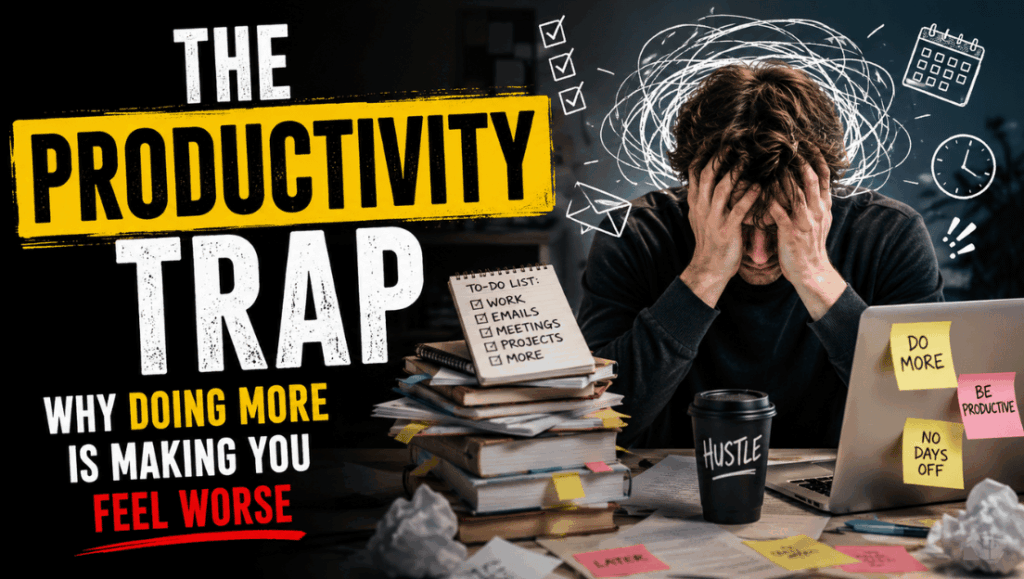
The alarm goes off at six in the morning. Before the eyes are fully open, the mind is already running. There are emails to check, deadlines to meet, calls to prepare for, and a list that seems to grow longer by the hour. Breakfast is skipped or eaten in a hurry. The commute is spent scrolling through notifications. By the time the workday officially begins, exhaustion has already set in.
This is not a rare experience. This is Tuesday. This is also Wednesday, and Thursday, and most of Saturday.
For generations, society has sold a simple promise: do more, achieve more, and happiness will follow. Work harder. Stay later. Optimize the morning routine. Add another goal. Learn another skill.
The underlying belief is that productivity is the path to a good life, and anyone who feels unfulfilled simply has not worked hard enough yet.
But here is the quiet truth that many people are beginning to recognize: the more they do, the worse they feel. Despite checking every box, meeting every target, and filling every hour, there is an ache that does not go away. There is a tiredness that sleep does not cure. There is a restlessness that no achievement seems to calm.
This is the productivity trap. And millions of people are living inside it without realizing it.
What Is the Productivity Trap?
The productivity trap is not about laziness. It is not about a lack of discipline or ambition. It is a belief system, quietly absorbed over years, that equates a person’s worth with their output. Under this belief, rest feels like failure. Doing nothing feels irresponsible. Even vacations become opportunities to catch up on work.
The cycle looks something like this: a task is completed, and for a brief moment, there is relief. Then comes a small, hollow feeling. So another task is added. Another project is started. Another goal is set. The temporary sense of achievement fades quickly, and the emptiness returns. To escape it, more is done. The wheel keeps turning.
The problem is not a lack of productivity. The problem is an excess of pressure, applied without pause, without meaning, and without genuine rest. It is not the amount of work that causes the damage. It is the inability to stop.
Why Doing More Is Not Making Life Better
To understand the trap more clearly, it helps to look at what constant busyness actually does to the human mind and body over time.
Constant Mental Overload
The human brain is not designed to operate at full capacity indefinitely. It needs periods of low stimulation to consolidate information, restore focus, and regulate emotion. When the day is packed from morning to night with tasks, meetings, notifications, and decisions, the brain never gets that recovery time. What follows is a kind of cognitive fog: difficulty concentrating, forgetfulness, poor decision-making, and a general sense of being overwhelmed even by small things.
This is not weakness. This is biology. The brain under chronic overload is a brain under stress, and stressed brains do not perform well or feel well.
Loss of Meaning
When activities are done at speed and in volume, they become mechanical. The person answering fifty emails in an hour is not engaging meaningfully with any of them. The person rushing through a meal to get back to the laptop is not nourishing themselves. The person ticking off goals on a spreadsheet may be making progress on paper while feeling completely disconnected from why those goals mattered in the first place.
Meaning requires presence. And presence is the first casualty of a life lived in constant motion.
Rest Feels Uncomfortable
One of the clearest signs of the productivity trap is what happens when there is nothing to do. Instead of feeling peaceful, the mind races. A list of unfinished tasks surfaces. Guilt sets in. The body sits still, but the brain is still running at full speed, scanning for the next problem to solve.
This is a particularly cruel dimension of the trap. The person caught inside it cannot even enjoy rest when rest is available. Their nervous system has been trained to equate stillness with danger, and activity with safety. Even leisure activities become performative: the run tracked on an app, the book read to meet a reading goal, the holiday documented in real time.
Emotional Exhaustion
Burnout does not arrive with a dramatic announcement. It accumulates slowly, beneath the surface of a life that looks perfectly functional from the outside. A person can be meeting every deadline, showing up to every commitment, and smiling through every meeting, while quietly running on empty inside.
Emotional exhaustion is not the same as physical tiredness. It is a deeper kind of depletion, one that does not respond to a good night of sleep. It shows up as irritability, emotional flatness, a reduced capacity to care, and a growing sense of going through the motions without any real engagement.
Achievement Without Satisfaction
Perhaps the most disorienting part of the productivity trap is reaching the goal and feeling nothing. The promotion arrives, and the reaction is relief that the anxiety will briefly stop, not joy. The project is completed, and the first thought is about what comes next, not a moment of genuine celebration.
This is because satisfaction is not found at the destination. It is found in the quality of the journey: in connection, in presence, in the feeling of doing something that genuinely matters. When the journey has been spent in a state of chronic stress and speed, the destination offers no real reward.
The Hidden Cost of Always Being Busy
Beyond the personal toll, constant busyness quietly erodes the things that make life rich. Relationships become shallow when conversations are held while simultaneously checking a phone. Friendships drift when social plans are always rescheduled or cut short. Children grow through milestones while a parent is present in the room but absent in attention.
Health warnings are dismissed as inconveniences to be dealt with later. Sleep is treated as a variable to be optimized, not a need to be honored. Food is fuel consumed between tasks rather than nourishment shared with people we love.
Inner peace, the quiet sense of being settled in one’s own life, becomes a distant memory or a luxury for retirement. A busy life can look successful on the outside while feeling empty on the inside. And the tragedy is that the person living it often cannot see the gap between those two realities until something forces them to stop.
Why the Mind Gets Stuck in This Loop
Understanding why people stay in the productivity trap, even when it is making them miserable, requires looking at the forces that keep it running.
External validation plays a significant role. In many workplaces and social environments, busyness is treated as a badge of honor. The person who says they are overwhelmed is seen as important. The person who has a slow week is seen as underperforming. When a culture rewards visible effort over genuine output, people learn to perform busy-ness even when it is not serving them.
Comparison culture amplifies this. Social media presents curated versions of lives that appear both productive and perfect. The result is a constant, low-grade pressure to measure up, to do more, to be more, to show more. It is a race with no finish line and no clear rules, which makes it impossible to ever feel like enough.
Fear of slowing down is perhaps the deepest anchor. For many people, activity is a way of avoiding something: a difficult emotion, a painful question about life direction, a relationship that needs attention, or simply the discomfort of being alone with one’s own thoughts. Staying busy is a form of avoidance dressed up as ambition. Slowing down feels like falling behind, even when it is exactly what is needed.
The Turning Point
The turning point is not about abandoning ambition or choosing a life without purpose. It is about recognizing that the current relationship with work and time is not sustainable, and that something more fundamental needs to shift.
The solution is not to escape life, but to change the way it is experienced. It is to ask not just what is being done, but why. Not just how much is being produced, but what it actually feels like to live this way. It is to reclaim time not as something to be filled, but as something to be inhabited.
This shift often does not happen gradually. It usually requires something that breaks the rhythm long enough for a new perspective to emerge.
How to Step Out of the Productivity Trap
Redefine What Productivity Means
True productivity is not about the number of tasks completed. It is about meaningful output: doing things that actually move life in the direction it needs to go, with the quality and attention they deserve. A single hour of deep, focused, meaningful work is more productive than six hours of scattered, stressed, half-present effort. Redefining productivity around meaning rather than volume changes everything.
Create Genuine Spaces in the Day
Brief pauses without screens, without tasks, and without stimulation can have a surprisingly powerful effect on the nervous system. These are not wasted minutes. They are the moments in which the brain recovers, creativity returns, and the ability to think clearly and feel calmly is restored. A ten-minute walk with no destination, a few minutes of sitting quietly with a warm drink, a short pause between meetings where nothing is done, these small rituals of stillness are not indulgences. They are essential maintenance.
Reconnect with the Physical Body
The productivity trap is largely a condition of the mind, and one of the most effective ways to interrupt it is to bring attention back to the body. Walking slowly and noticing what surrounds, eating a meal without multitasking, breathing deeply and deliberately, these are not spiritual concepts reserved for retreat centers. They are practical tools for resetting an overloaded nervous system. When attention lands in the body, it leaves the list. And when it leaves the list, even briefly, something begins to soften.
Reduce Unnecessary Stimulation
The modern environment is saturated with input. Every notification, every news headline, every social media scroll, and every ambient sound is a small demand on cognitive resources. Reducing unnecessary stimulation, turning off non-essential notifications, choosing silence over background noise, limiting news consumption to specific windows, creates space for the mind to settle. Mental quiet is not emptiness. It is the condition in which clarity, creativity, and genuine rest become possible.
Spend Time in Natural Environments
Research consistently supports what many people already know intuitively: time in nature reduces stress, lowers cortisol levels, improves mood, and restores the attention that modern life depletes. Parks, open fields, riversides, gardens, even a few trees on a quiet street, offer the nervous system something it cannot find in an office or a screen. The mind slows down naturally when the environment is calm. Nature does not hurry, and in its unhurried presence, something in the human body remembers how to stop.
When Small Changes Are Not Enough
These practices matter. They help. But for many people, daily life quickly pulls them back into the same cycle. A few days of intentional rest are followed by a week of overcompensation. A commitment to slow mornings dissolves under the pressure of a busy inbox. The environment keeps producing the same patterns, even when the intention to change is genuine.
This is because habits are shaped by environment as much as by will. When the environment stays the same, the same triggers produce the same responses. The phone sits on the desk, the inbox is always one click away, the city keeps moving at its relentless pace. Short breaks help, but deeper recovery often needs a complete shift in environment, a place where the default is different, where the rhythm is slower, and where there is nothing to optimize.
Experiencing Life Beyond the Productivity Cycle
There are environments where the pressure to perform simply does not exist. Where the day is shaped by light and weather and appetite rather than calendars and notifications. Where the measure of a good morning is not how much was accomplished before nine o’clock, but whether the sunrise was noticed, whether the food was tasted, whether there was a moment of genuine stillness.
Off-grid and farm-based living offers this kind of alternative rhythm. In spaces designed around sustainable living and genuine connection with the land, the noise of the productivity culture fades naturally. There are no performance metrics in a vegetable garden. There is no urgency in watching the sun set over an open field. The body remembers what it is like to breathe without an agenda.
These spaces do not ask anything of the people who enter them. They simply offer a different way of being: slower, quieter, more grounded, and more real.
A Different Kind of Reset
For those who feel deeply caught in this cycle, a brief but complete change of environment can create a shift that weeks of good intentions cannot. Offgrid Rajasthan, nestled in the peaceful countryside of Village Mangalwa, Bansur, offers exactly this kind of experience.
A family-owned farmstay designed around sustainable living, authentic Rajasthani culture, and immersion in nature, Offgrid Rajasthan is not a resort in the conventional sense. It is a space where the pace of life changes completely. There are open skies, organic meals, working farms, bonfire nights, and stargazing. There is room to breathe, to walk without a destination, and to simply exist without the weight of a to-do list.
Whether it is a weekend away or a longer stay, stepping into this environment creates a powerful contrast. And contrast, more than any productivity hack, is often what the overworked mind needs to finally remember what rest actually feels like.
Explore Offgrid Rajasthan and plan your stay
The Real Shift
The productivity trap is not a personal failing. It is a collective condition, shaped by culture, technology, and a set of beliefs about what makes a life worthwhile. And like any condition shaped by environment and belief, it can be changed.
The first step is simply recognizing that the exhaustion is not a sign of weakness. It is a signal. It is the body and mind communicating, in the only language available to them, that something fundamental needs to change. Not more strategies. Not better time management. Not another morning routine. Something deeper.
The problem was never ambition. The problem was imbalance. A life built entirely around doing will always feel incomplete, because human beings are not machines designed to produce. They are living creatures who need beauty, stillness, connection, meaning, and rest as much as they need purpose and progress.
Doing more is not always the answer. Sometimes, the real shift begins when one learns how to simply be.